Enterprise AI agents pay off when they become teams
The business case for enterprise AI agents is teams, not smarter assistants. Where the value shows up, what governance has to exist, and how I would start.

The real shift is from assistants to teams
Most of what companies have bought from AI so far is assistants. One model, one person, one chat window. The gains are real, but they all stop at the same limit. An assistant moves exactly as fast as the person typing to it.
Every task starts when a human types. Every task ends when a human copies the answer somewhere useful. What you get back is a transcript, and a transcript is not finished work.
The change worth watching is agents that hand work to each other. Microsoft made that case in December 2025, in a post on the rise of multi-agentic systems. Their description of the limit is right. One agent stalls on long work with many steps. The next stage is a team, with one orchestrating agent giving work to specialists and collecting the results.
Microsoft's proof is customer stories with numbers attached. Those numbers come from Microsoft's own December 2025 post, so read them as Microsoft's claims rather than mine. A managed security provider cut incident response from 30 minutes to about 30 seconds. A biomedical research company reported timelines cut by up to half. A retailer split support triage, account management, recommendations, and compliance across dedicated agents.
I build a platform in this category, so I am not a neutral source here. A team moves numbers that an assistant cannot, and the reason is routing. With an assistant, you are the router. You carry context between steps, you decide who does what next, you paste one tool's output into another.
A team moves that routing into the software. The human then works at the two points where a human was always needed: setting direction, and approving what ships.
Where the value shows up: response time, throughput, coverage
A governed agent team pays off in three places. Each one has a mechanical reason behind it. That reason tells you whether the gain applies to your business. A testimonial does not.
Response time. In a human process, a five-step task is five queues. The work itself might take ninety minutes. The elapsed time is a week, because every hand-off waits for someone's attention. An agent team runs the middle of the process at machine speed, and the only queue left sits in front of a human decision. That is why the incident-response story works the way it does. Triage, enrichment, correlation, and a drafted response contain no step that has to be human, until someone decides what to act on.
Throughput. One assistant per person means your limit is how much attention your staff has. An agent team removes the human from the space between steps. Ten projects move forward while your staff sleeps, and people review in batches instead of watching one task at a time. The constraint moves from "who has time to do this" to "who has time to check this". That second constraint is much easier to manage.
Coverage. Nobody advertises this one, and I think it is the most valuable of the three. Every company carries a long list of work that never gets done at all. The regression test nobody wrote. The backlog item that never got acceptance criteria. The doc that stopped matching the code a year ago. That work does not get faster with an agent team. It goes from never done to done. No dashboard was measuring it, because you cannot measure the speed of work that never happened.
None of this needs a smarter model than the one already in your chatbot. It needs structure: roles, routing, and review. I walk through when that structure beats a single agent, and when it is overkill, in multi-agent systems.
One ticket, walked through
Case studies hide the mechanics. Check this scenario against your own process instead.
A payment webhook starts failing for one of your customers. In the familiar path, the report sits in a triage queue until standup. Then it gets assigned, and an engineer stops feature work to reproduce it. The fix takes forty minutes. The reproduction, the context switch, and the review queue take three days.
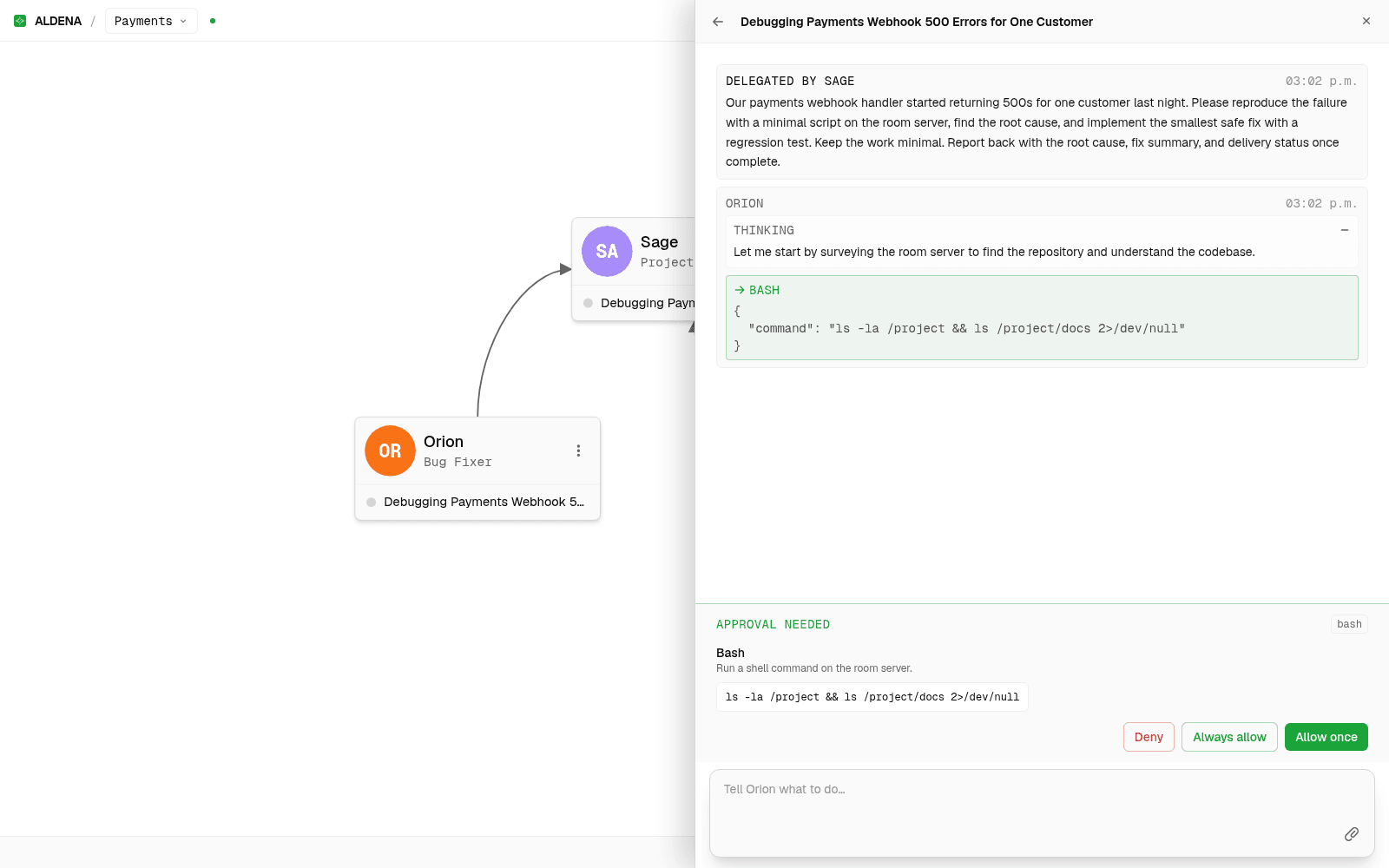
Now the same ticket, handled by a team of agents. You hand the report, in plain language, to the top of the org chart in a room. A room is one project's private workspace, and the org chart is the reporting diagram inside it. The project manager passes it to the bug fixer. The bug fixer clones the repository on the room's own server, reproduces the failure, and finds the root cause. It then writes the regression test that fails before the fix and passes after. The delivery manager branches, commits, pushes, opens a pull request, and stops.
If shell commands in this room are set to ask, a person saw and approved the exact commands before they ran. That approval is the first point where a human is needed. The second is the person who reads the diff, the test results, and the reasoning, then decides whether it merges. No agent is set up to make that call for you.
I am deliberately not attaching a number to this, because I would be inventing it. What I can claim is structural. The human appears twice instead of continuously. Both appearances are decisions rather than labor. Everything between them runs at machine speed.
Whether you get a drop like Microsoft's 30 minutes to 30 seconds depends on your own process. The question is how much of your current elapsed time is queues. In most teams I have seen, it is most of it.
The governance that has to exist first
That walk-through only works if you can answer three questions before the first real task reaches an agent. None of them are about model quality. They are also what separates enterprise AI agents from a personal assistant with a good prompt.
What exactly can it do without asking? "Mostly autonomous" is not a policy anyone can audit. You need a rule per action. This tool runs without asking. This one pauses and shows a person the exact call before it happens. This one is not available in this project at all. The pause has to be durable, too. An approval that expires in minutes teaches people to pre-approve everything, and then the gate stops meaning anything.
What can a mistake reach? Scoped access means credentials granted per project, not one service account with keys to the whole company. How far a mistake can spread is a design decision you make up front, or an incident report you write later. Adding isolation to a shared workspace afterwards is far harder than starting with it.
Can you reconstruct what happened? A chat transcript is not an audit trail. Once output lands in real systems, you need the action log: what ran, on whose instruction, what it touched, who approved it, and what came back.
Two organizational requirements sit on top of those three technical ones. Every agent needs a named owner, because output nobody owns drifts until someone quietly switches the agent off. Review also has to be staffed. Output that arrives faster than anyone can read it gets approved unread, or ignored. Either outcome destroys the value you were buying.
Most stalled deployments I hear about failed on one of these five points, not on intelligence. The layer that answers all five across a fleet of agents is the control plane. That is the one place where these rules are set and recorded for every agent. I go deeper on it in AI workforce platform.
How an enterprise agent team works in aldena
Aldena is my attempt to build those answers into the product itself, instead of leaving them as a checklist someone has to remember.
Work happens in isolated rooms, one per project. A room owns a dedicated server, its own connected integrations and credentials, and its own memory. The agents hired into it can reach nothing outside it. Two rooms never share a filesystem, so scoped access is physical rather than a setting. When an engagement ends, you delete one room instead of removing its traces from everything else.
Routing follows the org chart you draw on a canvas. An agent reaches its direct reports and its own manager, nobody sideways. There are hard limits on how many pieces of work one agent can hand out at a time. A chain of hand-offs can only run so deep before it stops. The lines light up while work moves along them. You watch a wrong hand-off happen, instead of finding it in the logs later.
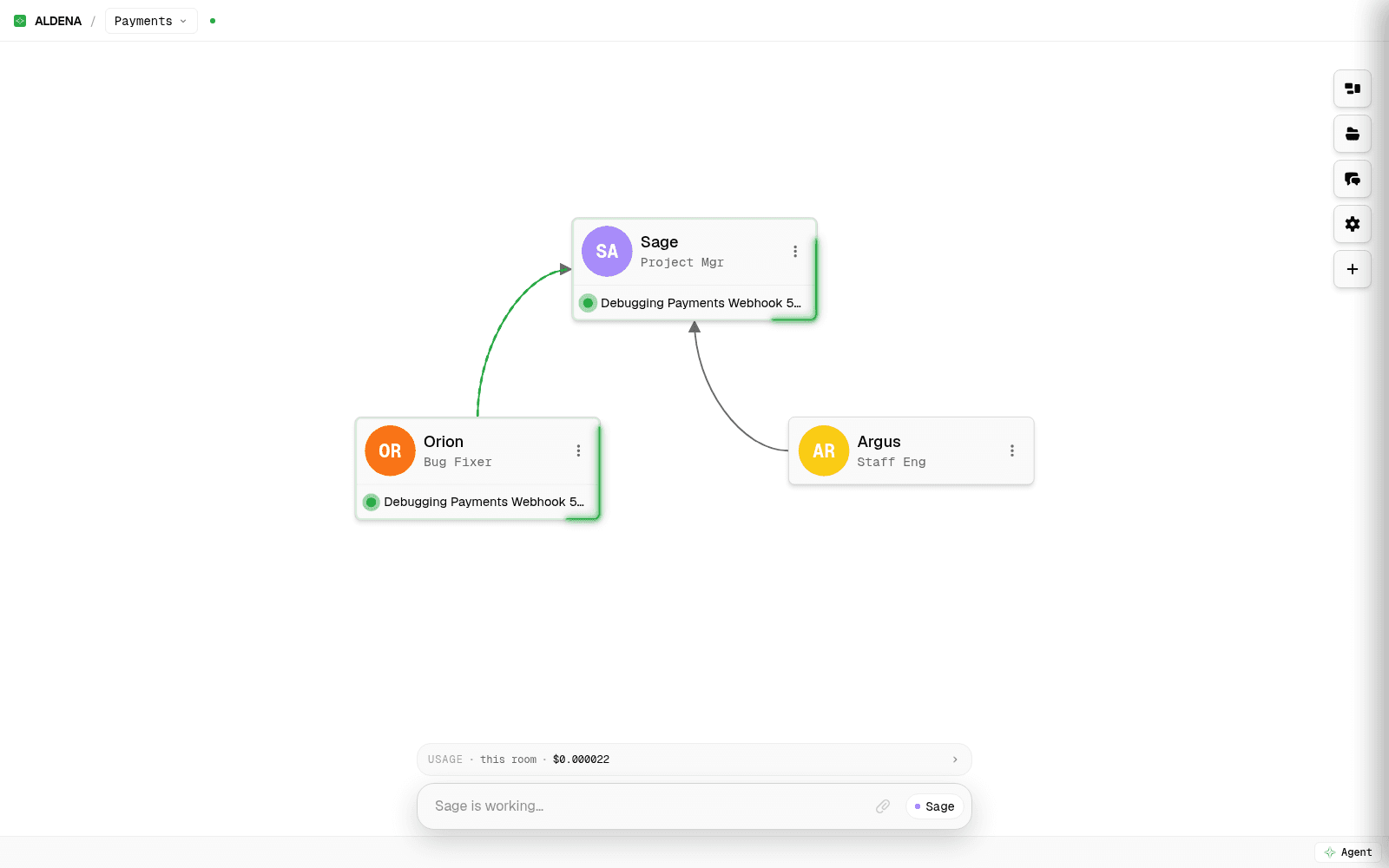
The approval gate is a policy on every tool: allow, ask, or deny, set per room. On ask, the run pauses and shows the exact call. The pause is durable, so answering an hour later resumes the run from the same step. Asking a person a question is itself a tool, and it is the one tool that can never be switched off.
The review gate is built into the roles. The delivery manager opens the pull request and stops. No agent merges its own work. The scrum master presents the whole proposed backlog and waits for an explicit go-ahead before creating a single ticket in your tracker. The details are on human in the loop.
The record keeps itself. Every chat, tool call, and generated file belongs to the room it happened in. A Memory tab lists what each agent knows, with the author on every shared entry. So "why did it think that" becomes a question you look up instead of argue about.
Delivery lands where your review already happens. Each room connects to the accounts that project already uses, from GitHub to Jira to Slack. Engineering work arrives as a pull request against your default branch, with the diff and the test results in front of the person who decides.
What the cost question is actually asking
Price is the first question after any demo, and the quotes in this category come in two shapes.
The first shape is the enterprise engagement. Through 2025 and into 2026, the quotes I have seen for enterprise pilots land between $25,000 and $75,000, and reach six figures a year at scale. That is my own read of the deals I have watched, not a published price list. Most of that price is integration and support, so it is a consulting project sold at a software price.
The second shape is platform pricing: a subscription plus metered usage. Aldena has two self-serve paid plans in the low hundreds a month and an enterprise tier priced case by case. The current prices are on the pricing page. Model usage and server time are metered at published rates against a prepaid balance. Work pauses when the balance runs out, so no invoice surprises you.
The monthly price is still the wrong number to focus on. The number that decides it is the cost of one completed piece of work. You also need to be able to see that number at all.
A metered platform gives you the number by default: this closed ticket cost this much in tokens and server hours. A services pilot cannot give it to you. That is why such a pilot feels safe and then never grows into anything. If a vendor cannot show you what one finished task cost, you are not buying a workforce, you are paying consultants who have an API. Only some multi-agent platforms can show you that number, and it is the first thing I check when I compare them.
Start with one process, not a transformation program
Every large vendor now sells an enterprise agent platform. Microsoft points buyers at its agent stack. Google launched the Gemini Enterprise Agent Platform in April 2026. Inside companies, the pressure is to answer with a program of the same size: a committee, an evaluation matrix, a phased rollout with a name.
I think that instinct is backwards. Agent teams reward what human teams reward. A clear job, a tight scope, and a manager who actually reads the work. A program produces none of those things.
The pattern that holds up is small and repeatable. Pick one narrow, high-volume process whose output you can check. Open one room. Hire the two or three roles it needs, and put the risky tools on ask. Name the owner, and agree on the number you will measure before you start.
Run it for a month against that number. If it holds, add the second process. The program can be written afterwards, out of what actually worked.
A transformation program starts with a slide deck. A digital team starts with one hire.
spin up your first room.
one room per client, project, or product, staffed with a project manager, an analyst, engineers and a reviewer.