human in the loop ai agents: approval gates and review
every tool an agent can reach runs under an ask, allow, or deny policy. agents stop mid-run to ask you, and code lands as a pull request they never merge.
human in the loop means an agent stops and waits for a person at the points that matter, instead of asking forgiveness afterwards. in aldena that is not a setting buried in one screen: every tool an agent can call carries a policy you set, agents can pause a run to ask you a question in plain language, and engineering work arrives as a pull request that no agent is allowed to merge. you decide how much rope to give, per tool, per room.
three policies, per tool
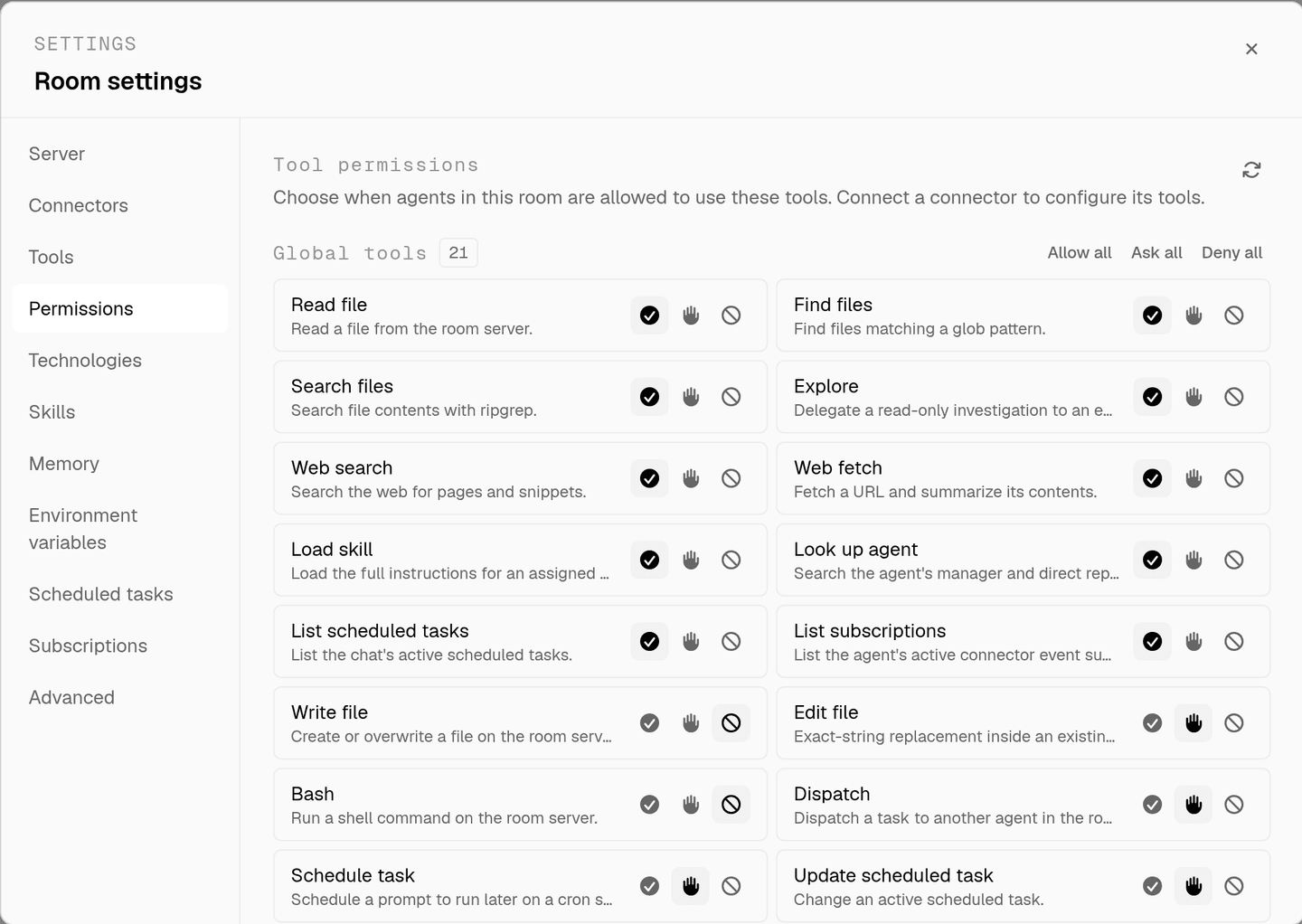
| policy | what happens | good for |
|---|---|---|
| allow | the agent uses the tool without stopping | reading files, searching, running the test suite |
| ask | the run pauses and shows you the exact call before it happens | writes, shell commands, anything in your accounts |
| deny | the tool is not available at all | anything this room has no business touching |
policies are set per room, in a Permissions tab that groups tools by where they come from: the built-in ones for files, commands, web access, and memory, plus whatever each connected integration brings with it. set a whole group with allow all, ask all, or deny all, then override the individual tools you feel differently about.
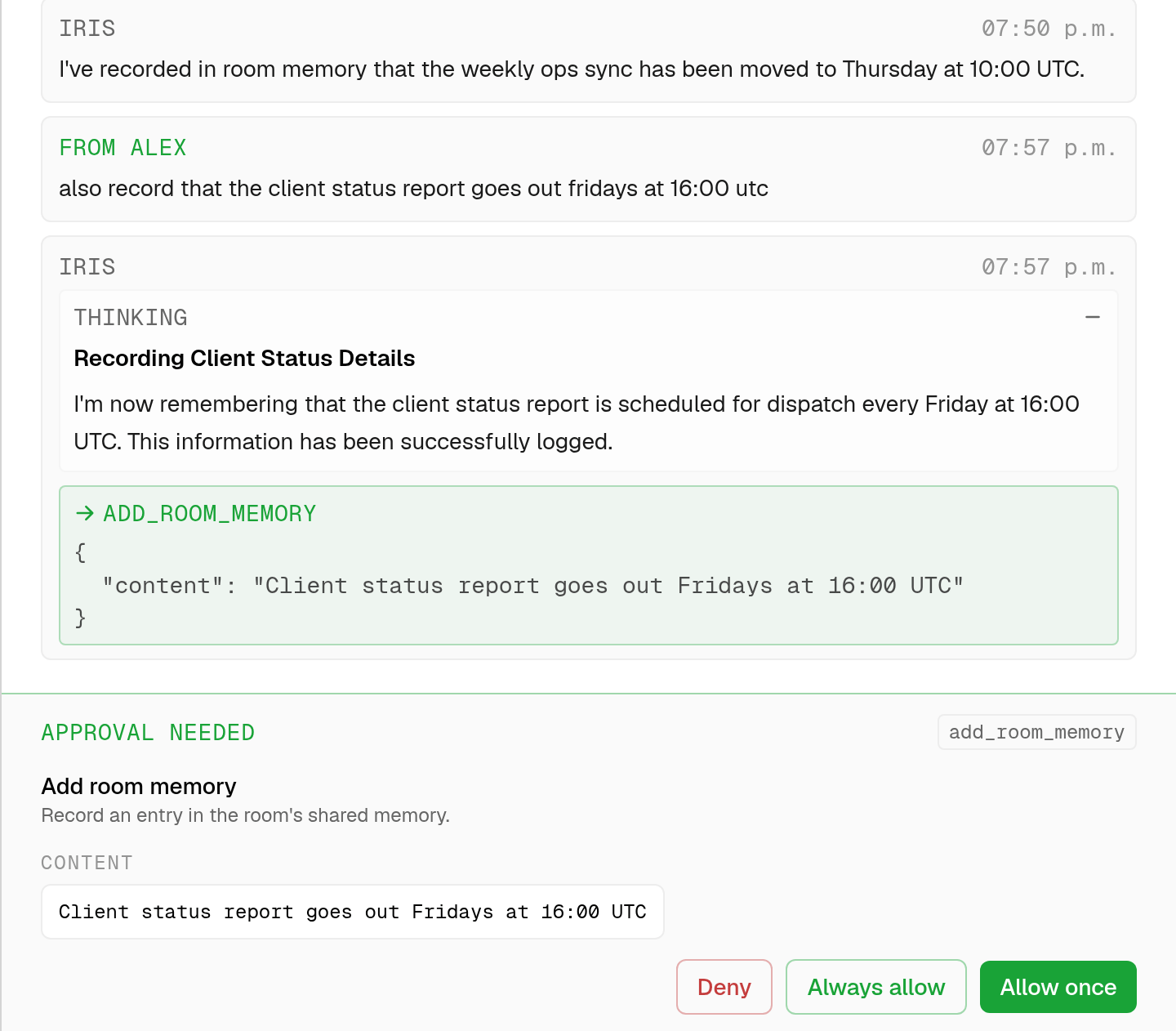
when a tool is set to ask, the agent stops and shows the exact call it wants to make. answer allow once, always allow, or deny, and the run continues from exactly where it paused. always allow writes the policy back for you, so a decision you have already made is not put to you twice.
agents ask you questions
asking a person a question is itself a tool, and it is the one tool that can never be switched off. an agent that hits an ambiguity stops and asks rather than guessing: which environment, which repository, is this in scope. the analyst role is built around it and asks its clarifying round before it writes a line of the spec.
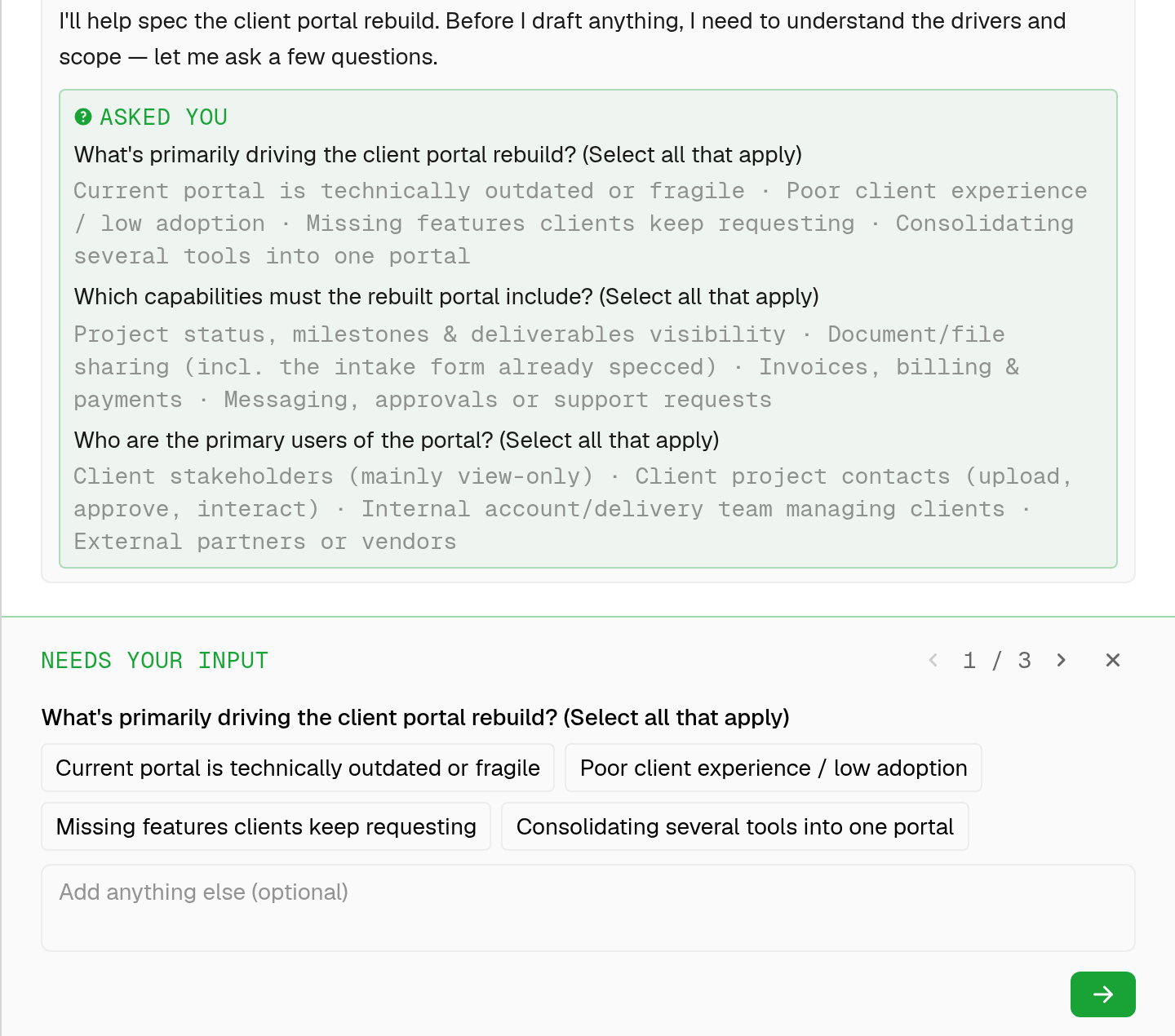
a paused run is durable, not a held-open connection. answer an hour later and the agent resumes with everything it had. that is what makes the pause safe to rely on.
the review gate holds
for engineering work the last step is deliberate: the delivery manager branches, commits, pushes, and opens a pull request against your default branch, then stops. no agent merges its own work. the diff, the test results, and the reasoning are all in front of you before anything reaches your main branch.
the same shape shows up elsewhere. the scrum master presents the whole proposed backlog and waits for an explicit go-ahead before it creates a single ticket in your tracker. scheduled work and event subscriptions an agent set up for itself are listed in room settings so you can see what is on the books and cancel it.
the concierge asks too
the built-in assistant that sets up teams, rooms, agents, and billing on your behalf runs under its own permission list in your account: teams and members, rooms, agents, skills, technologies, environment variables, scheduled tasks, room tools, billing and credits, and account settings. same three policies, same prompt before it acts.
pair this with isolated rooms, which bound what any approval could reach in the first place, and with the org chart, which decides who was doing the work when the prompt appeared.
faq
will agents go off and change something on their own?
only where you set the policy to allow. anything on ask stops and waits for you, anything on deny is not available at all, and pull requests are never merged by an agent.
can i run a room hands off?
yes. set a group of tools to allow all and the room runs without stopping. you can keep the risky groups on ask while the routine ones run free.
what happens to a run while it waits for me?
it is suspended, not lost. answering resumes it from the exact step it paused at, whether that is a minute or a day later.
can an agent be stopped from asking me things?
no. questions to a human are exempt from the policies on purpose, so an agent can always reach you rather than guessing.
does approving something once mean approving it forever?
only if you choose always allow, which writes that policy back. allow once covers exactly the call in front of you.
spin up your first room.
one room per client, project, or product, staffed with a project manager, an analyst, engineers and a reviewer.