An AI workforce platform is a control plane, not a chatbot
What an AI workforce platform does, how hiring an AI worker differs from building one, and how Aldena models a workforce with rooms, hierarchy, and approvals.

The job an AI workforce platform actually does
"AI workforce platform" sounds like a phrase someone invented for a pitch deck. I want to define it before marketing takes over the term. An AI workforce platform is the layer that lets you run many AI workers the way a company runs staff.
You hire each worker into a defined role. Work moves between them along a reporting line, so you are not the one passing every message by hand. Every action they take goes through a permission policy, and their costs are metered against a budget. Their output lands in the systems your team already uses, not in a chat transcript.
Three nearby things get sold under the same name. A chatbot seat is not a workforce. A copilot subscription gives one assistant to one person, and the result stays inside that one conversation. It is a useful tool, but somebody still has to sit there and operate it.
An agent framework is not a workforce either. A framework is a library you build on. You write the code that routes work between agents. You host it and build the permission system yourself. When it breaks, you are the one who fixes it. Frameworks are what platforms are made from, and running one yourself means maintaining a second product.
A single autonomous agent with a long to-do list does not make a workforce. One agent has no division of labor, so there is nothing to route and nobody to check the work. When it gets something wrong, there is no structure to look at.
The workforce idea only becomes useful once you have several workers with different jobs. Something has to decide who does what, what each one may touch, and who reviews the result. That something is the platform. I defined the term itself in a separate piece on AI employees. This post is about the layer that manages them once there are many.
Hiring an AI worker is not building one
Building a worker and hiring one are two different acts. Humatron's platform overview states that split more clearly than anything else I have read. Building means writing a worker template once: the role, the instructions, the integrations, the behavior. Hiring means starting a live copy of that template, as many copies as you need, each one running on its own.
They sum it up as one build, many hires. The slogan is right about the economics. A role definition is something you invest in once. Staffing is a decision you make again on every project.
This matters because most teams do not want to build at all. They want to hire something that already works. Ask a founder to choose between two options. One is writing a job description, a working process, and a toolchain for a quality assurance function from scratch. The other is bringing in someone who arrives already knowing the job.
The answer is obvious for people, and it is the same for AI workers. A platform that only hands you a blank agent builder has made you the author of every role in your company. That is the framework experience with a friendlier interface on top.
Aldena takes the same position. It ships a roster of prebuilt roles, and each one has clear rules about what it owns and what it refuses. The business analyst asks its clarifying questions before it writes any of the spec. The engineering manager delegates the build and opens the pull request, but never writes code itself. The reviewer reports findings and never edits what it reviews.
You hire the roles a project needs from the agent roster and leave the rest alone. If no prebuilt role fits, you build a custom agent once, with your own instructions. It is versioned like code, and you promote it to the team. After that, any project room can hire its own copy, and each copy keeps its own memory. The definition is written once and hired many times.
What a control plane over AI workers has to cover
A control plane is the management layer: it decides who runs, with what permissions, and at what cost. Humatron calls its own control plane agent-agnostic. That means one governance layer over workers that run on different AI models underneath. I agree with the instinct. The model layer changes fastest, and the management layer is the part you cannot afford to rebuild every quarter. Whatever platform you evaluate, its control plane has to answer seven concerns:
- Identity and roles. Who each worker is, what it owns, and what it refuses to do. A role with no boundaries is only a prompt.
- Routing. Who may hand work to whom. A group chat where every agent hears everything is not routing, and it only adds noise.
- Permissions. One policy per action, instead of a single autonomy slider for everything. "Mostly autonomous" is not a policy anyone can audit.
- State. What a worker remembers between runs, who else can read it, and whether you can inspect and correct it.
- Isolation. How far one worker's mistake can reach. You decide that limit when you set the work up, not after something breaks.
- Cost. Metering per model and per machine, against a budget that stops the work when it runs out.
- Observability. You can watch the work happen and replay it afterwards, without reading raw logs.
A framework makes each of these a subsystem you write. A workforce platform makes each of them a setting you configure. That difference decides which one you should buy. I work through the same decision for the coordination layer in AI agent orchestration.
Aldena's answer to the agent-agnostic point is model choice per agent rather than per account. Every agent runs on a model you pick from the models page, and each agent carries its own reasoning effort setting. Usage comes out of one prepaid team balance at the published per-token rates. Put the reviewer on a heavier reasoning model on Monday and move it back on Friday. The role, its memory, and its place in the structure stay where they are.
How the workforce model works in Aldena
Aldena's control plane is built from two parts: the room and the org chart. Policy sits on top of both.
A room is the unit of employment
Work happens in isolated rooms, one room per project. A room owns a dedicated server, its own connected integrations and credentials, and its own memory. The agents hired into it can reach nothing outside it.
On that server they work the way a person works on a machine. They clone the repository, read and write files, run shell commands, install what the project needs, and run the test suite.
Two rooms never share a filesystem, so a mistake stops at the room boundary. Ending a client engagement means deleting one room, instead of searching a shared workspace for whatever the project left behind. The full mechanics are on the isolated rooms page.
The org chart is the routing table
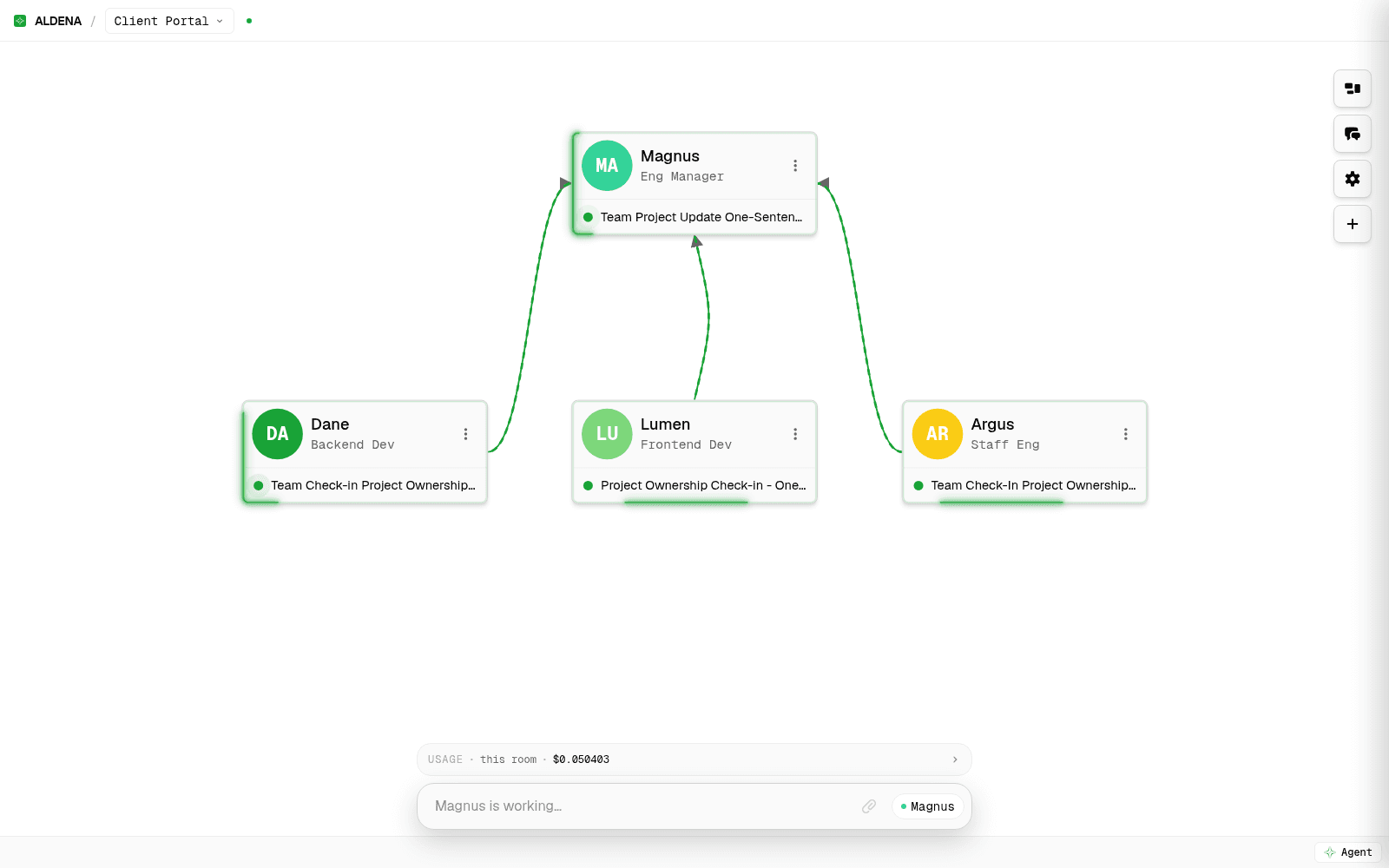
Inside a room you arrange the agents on a live canvas into an org chart, a picture of who reports to whom. Drag a line from an agent to its manager and that connection is the whole configuration. From then on an agent can reach its own direct reports and its own manager, and no one else.
You give the top of the chart a request in plain language. The manager finds the right report by capability, and results come back up the same lines. Hard limits keep the traffic under control. An agent can only hand out a few pieces of work per turn, and a chain can only run so deep before it stops.
A room holds one checkout that all its agents share, so a delivery manager works with one report at a time. That is what keeps two agents off the same code at once. The lines light up while work moves along them. A hand-off that went to the wrong place is visible on the canvas, so you do not have to search the logs for it.
Approval is a policy on every tool
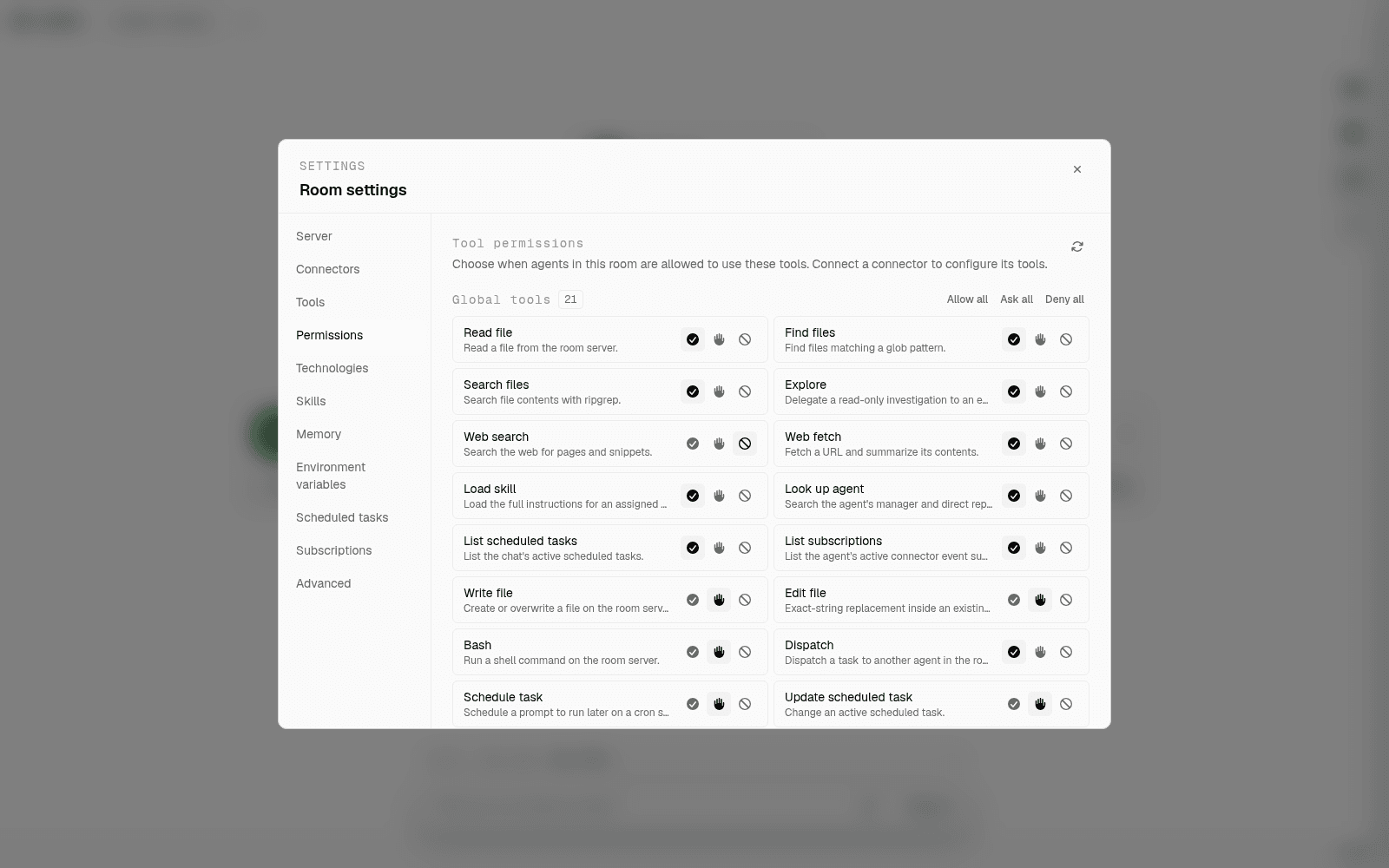
Every tool an agent can call carries one of three policies you set per room: allow, ask, or deny. On ask, the run pauses and shows you the exact call before it happens. A paused run is durable, so you can answer an hour later and it picks up from the same step. Asking a person a question is itself a tool, and it is the one tool that can never be switched off.
Engineering work has an approval gate built into the process, a point where a person has to say yes. The delivery manager branches, commits, pushes, and opens a pull request, then stops. No agent merges its own work. That is the human in the loop layer. It turns "autonomous" into a dial you set per tool rather than a promise you have to trust.
Memory is the institutional knowledge
Each agent keeps private memory that only it reads. Each room also keeps shared memory, meaning notes that every agent in that room can read. The assistant records the lasting project facts, and specialists record what their own work depends on. All of it survives the conversation that created it.
A Memory tab in room settings lists every entry with its author. That makes "why did it think that" a question you can look up. A wrong fact gets removed by telling the agent it is stale. Details on agent memory.
A worker is only a worker where the output lands
Humatron makes a point most platforms skip. Their workers show up as managed team members in the channels a company already runs on, like email and Slack. They do not live inside one more chat window. If you have to open a separate app to collect a worker's output, that worker is still a demo.
Aldena's version of that test is delivery. Integrations connect per room. You pick the accounts that project runs on, whether that is GitHub, Linear, Slack, or one of the other connectors. Engineering work arrives as a real pull request against your default branch. The diff, the test results, and the reasoning are all in front of you.
The scrum master proposes a backlog and only creates the tickets in your tracker after you say yes. Documents land in Drive and updates land in Slack. Your review tools stay your review tools. You read an agent's work in the same place you read everyone else's.
Questions I would ask any AI workforce platform
If you are comparing platforms in this category, the demos will all look alike. Ask about the control plane instead:
- Can I hire a defined role today, or does every worker start from a blank builder?
- When one worker hands work to another, what decided the route, and can I watch it happen?
- What is the exact list of actions a worker can take without a person approving, and where do I change it?
- How far can one worker's mistake reach, and is that limit enforced by the system or only promised?
- What will this worker still know next week, and can I read and correct it?
- Where does finished work land, and who is allowed to merge it?
- Can I change the model under a worker without rebuilding the worker?
A real platform answers these with screens, not paragraphs. You do not need a company-wide rollout to get those answers. Open one room, hire an analyst, a developer, and a reviewer, and give them one deliverable you actually need. I lay out that first project in how to build an AI agent team.
An AI workforce is not something you adopt in one announcement. You staff it one hire at a time.
spin up your first room.
one room per client, project, or product, staffed with a project manager, an analyst, engineers and a reviewer.