ai agent roster: eleven prebuilt roles you hire into a room
aldena ships named agents for the roles a delivery team needs, from analyst to reviewer to bug fixer. hire the ones you want and pick each one's model.
a prebuilt ai agent role is an agent that arrives with a job already defined: what it owns, what it refuses to do, and who it hands work to. aldena ships eleven of them, each named, each with its own working instructions and traits. you are not writing personas from scratch and you are not talking to one general assistant wearing different hats: you hire the roles a project needs and leave the rest on the shelf.
the roster
| agent | role | what it owns |
|---|---|---|
| Iris | assistant | runs the room, records project and client facts, sets the workspace up |
| Sage | project manager | the front door for requests, routes them, reports results back to you |
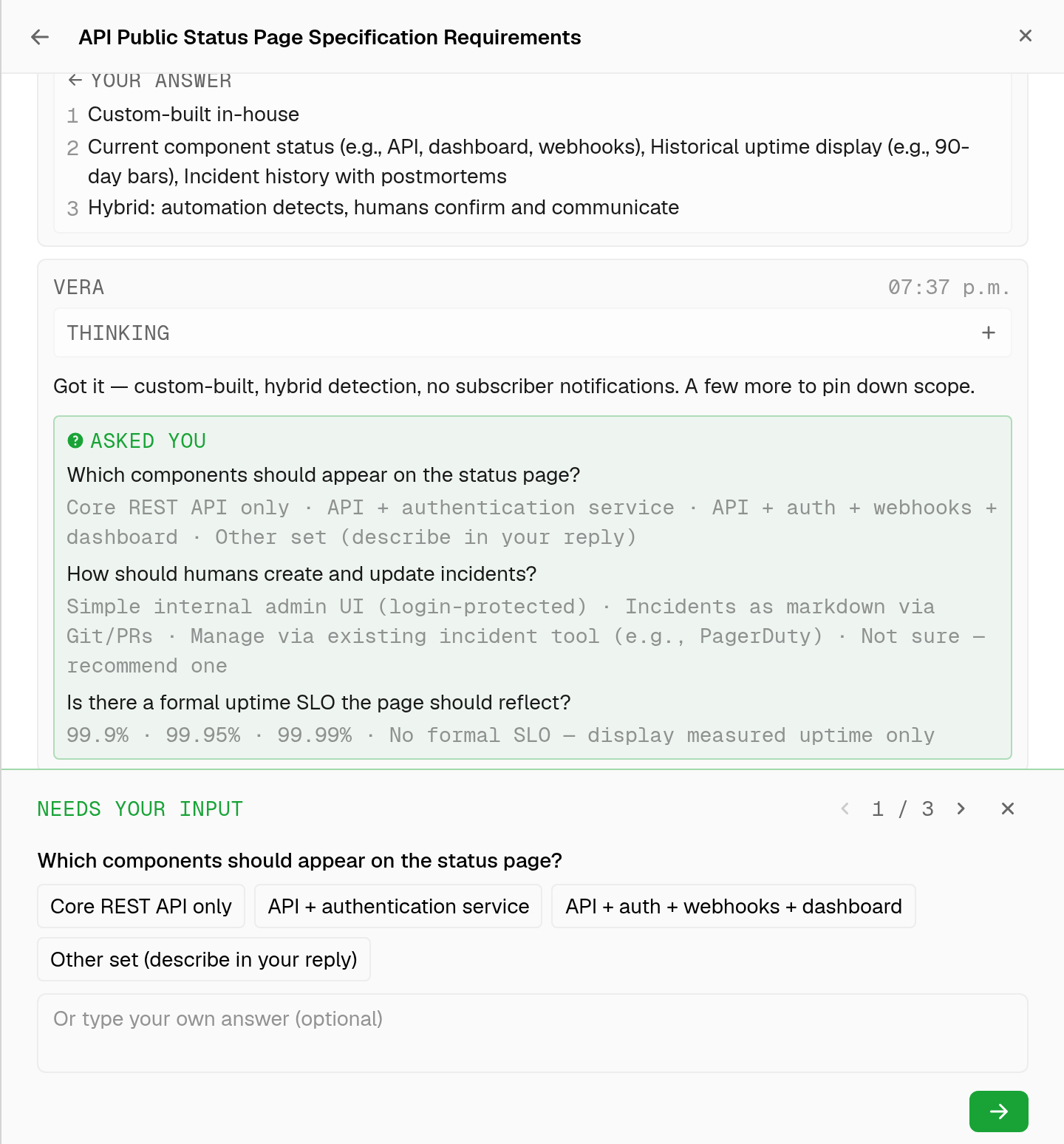
| Vera | business analyst | asks the clarifying questions, then writes the spec with acceptance criteria |
| Atlas | scrum master | slices an approved spec into work items and pushes the backlog to your tracker |
| Pallas | solution architect | turns requirements into a buildable architecture: components, data model, contracts |
| Magnus | engineering manager | delegates the build, drives the review loop, commits and opens the pull request |
| Dane | backend developer | schema, migrations, services, endpoints, and the tests behind them |
| Lumen | frontend developer | pages, components, state, and forms, wired to the real backend |
| Nova | full-stack developer | one feature end to end across both lanes when you would rather not split it |
| Argus | staff engineer | reviews the diff across five lenses and reports findings, never edits code |
| Orion | bug fixer | reproduces the failure, fixes the root cause, pins it with a regression test |
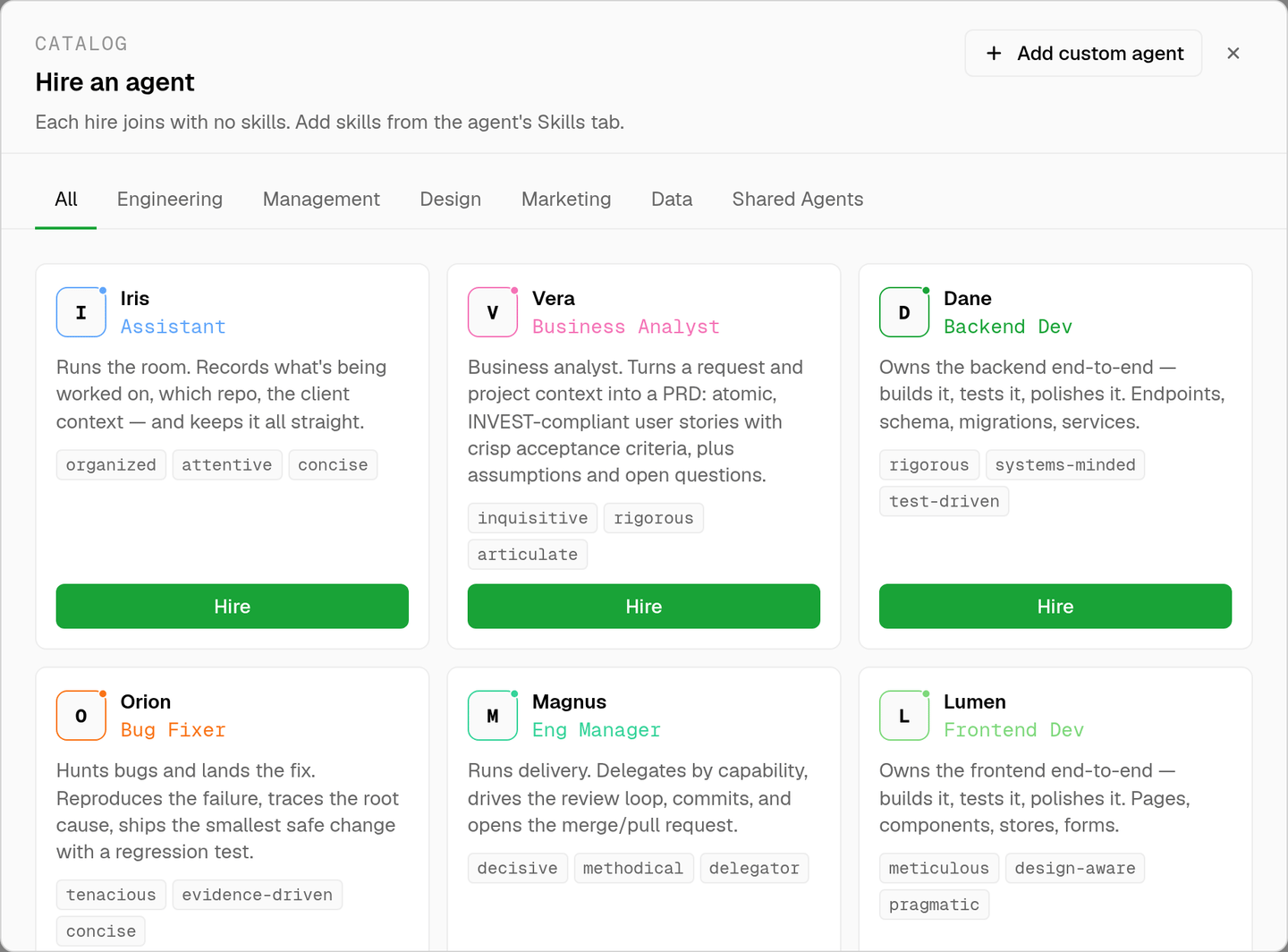
the roles are opinionated on purpose. the analyst asks before it writes. the engineering manager never writes code itself, only delegates and then opens the pull request. the reviewer never edits what it reviews. those boundaries are what make a hand-off mean something.
every agent picks its own model
model choice is per agent, not per account. run the reviewer on a heavyweight reasoning model and the room assistant on something cheap and fast, then change your mind next week. each agent also carries a reasoning effort, from low up to max, so you can spend more thinking where it pays.
usage comes out of one prepaid team balance and is charged at the provider's list rate. every supported model, with its rate, is on the model pricing page, so the cost of a swap is something you can look up before you make it.
custom agents when the roster runs out
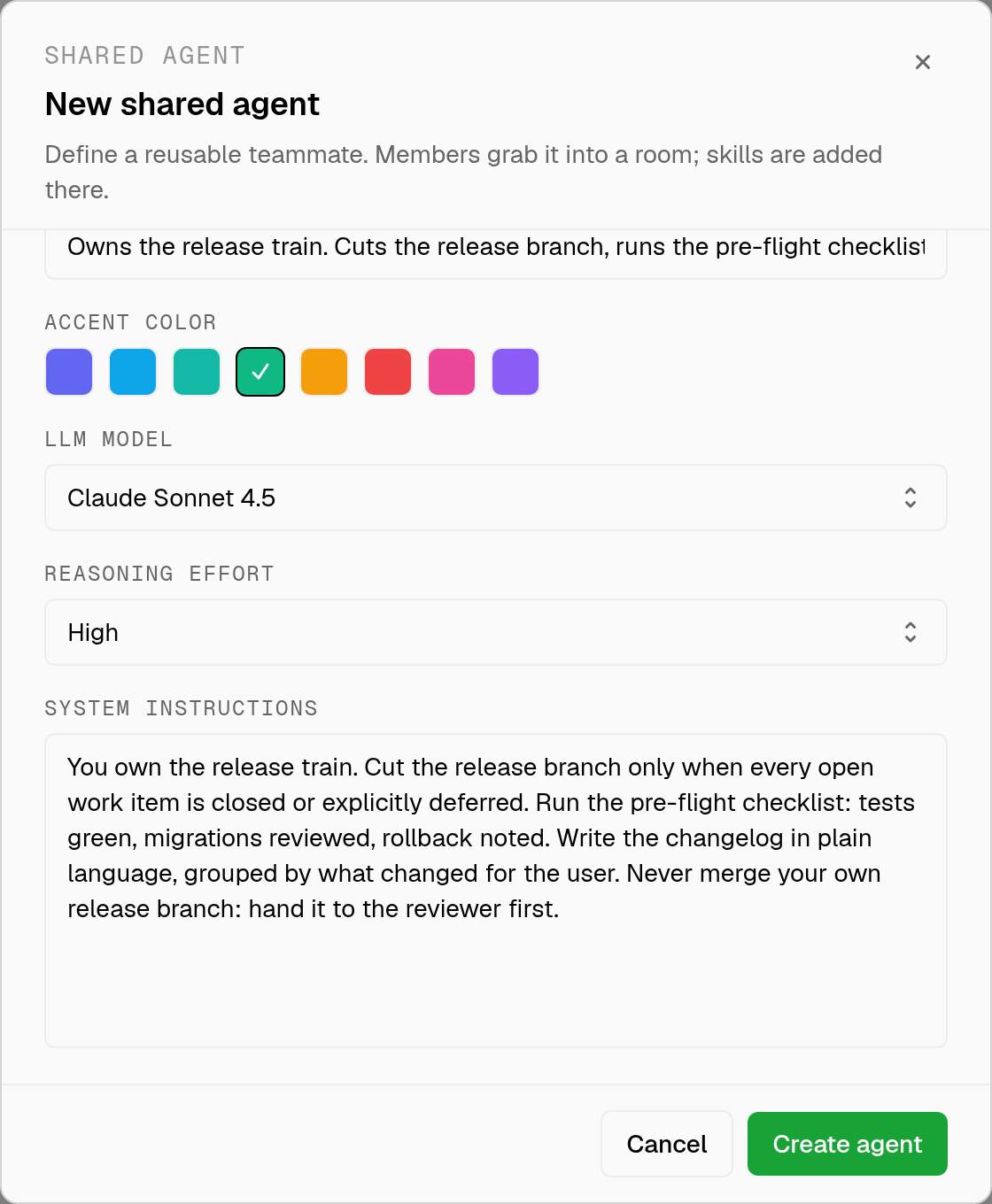
build your own from the same parts: a name, a role, a bio, a department, up to six traits, an accent color, and up to 8000 characters of instructions, on the model you choose. custom agents behave like the prebuilt ones everywhere else, and they are versioned, so editing one keeps the history and you can go back to an earlier version. promote a custom agent to the team and any room can hire it.
how the roster becomes a team
hiring is only half of it. the agents you hire get a reporting structure on the org chart, each keeps what it learns in agent memory, they carry the skills you attach, and everything they do in your accounts passes the approval gate first.
faq
do i have to hire all eleven?
no. a room with an analyst, one developer, and a reviewer is a normal starting team. hire more when a hand-off you keep doing by hand should belong to someone.
how are these different from one assistant with different prompts?
each agent has its own instructions, its own memory, its own model, and its own place in the org chart. they hand work to each other and report back, which one context switching hats cannot do.
can i change what an agent does?
yes. adjust its model and effort, attach skills, or build a custom agent with your own instructions when the shipped role is not the one you want.
what if two rooms need the same custom agent?
promote it to the team. it becomes available to every room, and each room hires its own copy with its own memory.
which agent talks to me?
any of them. you can message an agent directly, and in a room with a hierarchy you usually talk to the top of it and let the work travel down.
spin up your first room.
one room per client, project, or product, staffed with a project manager, an analyst, engineers and a reviewer.