Multi-Agent Systems: How They Work and Who Needs One (2026)
How multi-agent systems decompose work, coordinate, and fail in production, plus a plain test for when a single agent is the cheaper, better call.

A multi-agent system is a cost you take on deliberately
I run a company whose product is a multi-agent system. The first thing I tell people is that most tasks do not need one. A team of agents gives you specialization, parallel work, and independent review. You pay for all three in coordination overhead, extra model calls, and failures that are harder to trace. That deal is better in 2026 than it was two years ago. The cost is still real. Using a team when one agent would do is the most common architecture mistake I see.
This post is the practical half of the topic. How these systems work, where they break, and how to decide. The strict definition and the forty years of research behind the term sit in a separate post, what is a multi-agent system. The short version is enough here. Several agents share one environment. Each one sees only part of it. Together they work toward a result that none of them controls alone.
Five traits, and the one that matters most
Most write-ups list the same traits. Dust's guide to multi-agent systems names autonomy, specialization, coordination, decentralization, and scalability. That list matches what I see running one in production. What the lists rarely say is that the traits are not equal.
- Autonomy. Each agent picks its own next action inside its own area of work. Without that you have a fixed workflow with model calls in it. That can be a fine thing to build, but it is not a multi-agent system.
- Specialization. Each agent carries a narrow prompt, a narrow tool set, and a narrow part of the problem. This is where the accuracy gains come from. An agent that only reviews code spends none of its context on how to write migrations.
- Coordination. Agents pass work to each other, share findings, and stay out of each other's way. Without this you have a set of disconnected tools that share a label.
- Decentralization. Decisions are spread out instead of passing through one controller. In practice nearly every commercial system is a hybrid. A coordinator hands out the work, and each specialist still decides how to do its own part.
- Scalability. You add an agent without redesigning what already works.
Coordination is the trait that matters. Autonomy and specialization are cheap, because you get them by writing different instructions for different agents. Scalability and resilience come free from a coordination design that holds up. Get coordination wrong and nothing else helps. Two capable agents that overwrite each other's work are worth less than one average agent working alone.
How a multi-agent system works
Four parts do the work. Every system I have built or studied is some arrangement of them.
Task decomposition and routing
A coordinating agent takes a request that is too big for one context window or one skill set. It splits that request into subtasks with clear boundaries. It sends each piece to the agent best suited to it, tracks what comes back, and puts the final result together. The router can be a dedicated orchestrator, or simply the manager at the top of a hierarchy. What matters is that the split is written down. Every subtask needs an owner, a definition of done, and a path for the result to travel back. When the split is vague, agents fill the gaps with guesses. Then two of them solve the same problem in two different ways. I cover the orchestration patterns themselves, and which ones hold up, in AI agent orchestration.
Perception, reasoning, action
Each agent runs its own loop. It reads its part of the environment: a copy of a repository, a ticket queue, a database, a shared document. It reasons over what it sees with the model behind it. Then it acts. It runs a command, edits a file, calls an API, asks a human a question, or hands a result to a teammate. A single agent runs the same loop. The difference is scope. A specialist sees less on purpose, and that narrow view is what keeps its reasoning focused.
Communication
There are two channels, and mature systems use both. Direct messages carry handoffs: here is the task, here is what came back. Shared state carries context, meaning the facts everyone needs, written once and read by all. The standards for this are becoming clear. MCP, the Model Context Protocol, covers how an agent reaches tools and data. A2A, agent to agent, covers how agents built on different frameworks talk to each other. The design question is older than both protocols. You have to decide which facts travel in messages and which ones live in shared state. My rule from production is simple. Decisions and results travel as messages, and durable project facts go into shared memory. Push everything through messages and you lose a little context at every handoff. Push everything into shared state and every agent has to read every other agent's noise.
Feedback and adaptation
The system improves without a rebuild, because its knowledge is data rather than architecture. Correct a fact in shared memory and every later run starts from the corrected fact. Tell the team that a failing test was already broken before their change, and nobody diagnoses it again next week. That loop is what makes a multi-agent system behave like a team that keeps notes. A script starts from nothing every time instead.
Where they break in production
Failure modes deserve more attention than diagrams usually give them. NVIDIA's glossary entry is one of the few vendor pages that treats drift, observability, and governance as real problems. My experience says those are the problems.
- Context loss at handoffs. The manager knew the constraint. The summary it passed down left the constraint out. The specialist then did clean work against the wrong spec.
- Duplicated and conflicting work. Two agents touch the same file, or the same ticket, because nothing made them take turns.
- Runaway delegation. Agent A asks B, B asks C, and C asks A something that starts the chain again. Without hard limits on how wide and how deep delegation can go, this spends real money before anyone notices.
- Cost multiplication. Every handoff means more model calls. My rule of thumb, from running these teams rather than from any published study, is that a five-agent chain costs about ten times what a single agent would. If the answer is not ten times better, you paid for complexity you did not need.
- Debugging across several agents. The wrong assumption entered at step two and showed up at step six. Tracing it back through four agents' reasoning is much harder than reading one agent's transcript.
None of these are rare. All of them show up in the first week you run a team on real work. That is why the decision matters more than any diagram.
When a multi-agent system is worth the cost
I look for these triggers, and I want at least two of them before I commit to a team:
- The work spans real specializations. Writing a spec, designing the architecture, building it, and reviewing the diff are different jobs. Each one fails in a different way. One prompt that tries to hold all four does each of them worse.
- Independent review changes the outcome. A reviewer that does not share the author's assumptions catches what the author cannot see. This only works if reviewer and author are separate agents with separate context.
- Subtasks genuinely run in parallel. Backend and frontend of the same feature. Research on three vendors at once. If the subtasks run one after another anyway, parallel work buys you nothing.
- The work outlives one context window. Delivery that runs over several days needs state that survives between runs. Durable shared memory handles that better than a single context window that keeps filling up.
- You want role boundaries enforced, not suggested. An agent that reviews code and cannot edit it cannot quietly fix and approve its own mistake. Structure beats instructions here.
A concrete example is feature delivery. An analyst turns a vague request into a spec with acceptance criteria. An architect turns the spec into contracts. Developers build against those contracts in parallel. A reviewer reads the diff without knowing how the author got there. A manager puts the pieces into a pull request. Five roles, real handoffs, real parallel work, and an independent reviewer. That is a multi-agent problem.
When a single agent is the better call
The signs that point the other way, which vendor content mostly skips:
- One job, one definition of done. Summarize this document, fix this bug, draft this email. A single agent is cheaper, faster, and easier to check.
- A tight latency budget. Latency is how long a user waits for the answer. Every handoff adds another model call and more waiting. If you need the answer in seconds, a team is the wrong design.
- The whole task fits in one context. Splitting the work gains you nothing when nothing needs splitting.
- You cannot name the roles yet. If you cannot write meaningfully different instructions for two agents, you do not have two agents. You have one agent and a wish. The second agent has no separate job to do.
- You cannot yet see what your one agent does. If a single agent's failures already surprise you, five coordinating agents will not make anything clearer.
Moving up later does not mean a rewrite. Start with one agent. Add the second when its prompt starts collecting unrelated jobs. Add it when you find yourself passing work by hand between two runs.
How this works in Aldena
Aldena is the design I argued for above. It is a hierarchy with a shared store underneath, sold as a product rather than a framework. It maps onto the four parts directly.
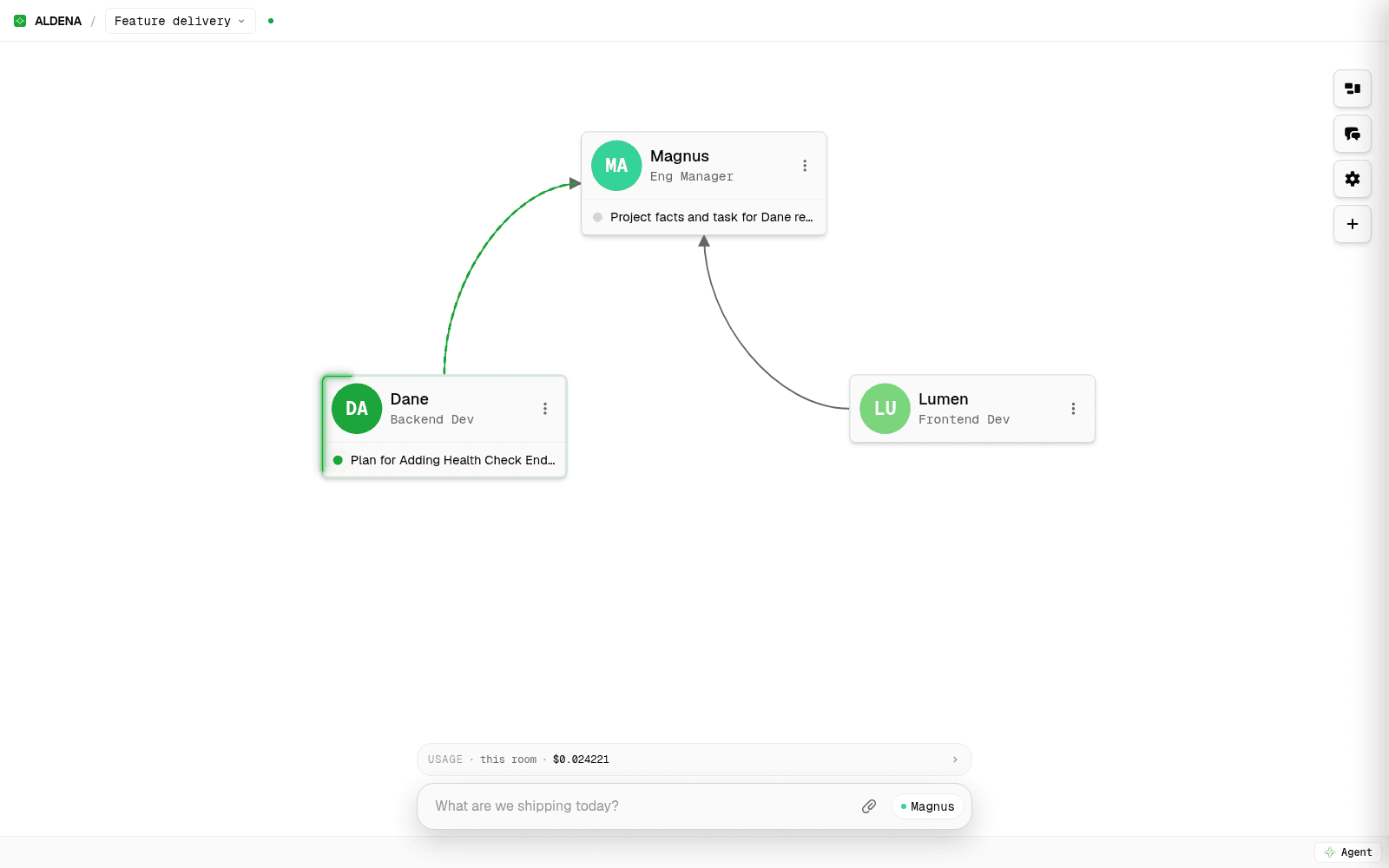
Decomposition and routing follow an org chart you draw. You hire agents from a roster of prebuilt roles into a room. A room is one workspace with its own agents and its own machine. Then you wire who reports to whom on a live canvas. That wiring is the routing table. An agent can reach its own direct reports and its own manager. It cannot reach anyone else. A manager finds the right report by capability, hands the work down, and reads the result back up. Runaway delegation is handled with hard caps. An agent can only hand out a few pieces of work per turn. A chain can only run so deep before it stops. Sharing the code is handled separately, and not by a cap. A room has one server holding one checkout, so the delivery manager is told to run one report at a time and keep two agents off it at once.
Perception happens on a real machine. Each room is an isolated environment with its own server, credentials, and integrations. Agents clone the repository, run commands, and run the test suite there. One room can never reach another room's files or secrets.
Communication is messages down the lines plus shared memory underneath. Handoffs travel along the reporting lines. Durable facts live in room memory, which has two layers. One layer is shared, and every agent in the room reads it. The other is private, and each agent keeps its own working state there. Both layers hold a capped number of entries, so the store stays short enough to stay useful. That split is the fix for context loss at handoffs. The reviewer already knows the conventions the developer was building to, because both read the same store.
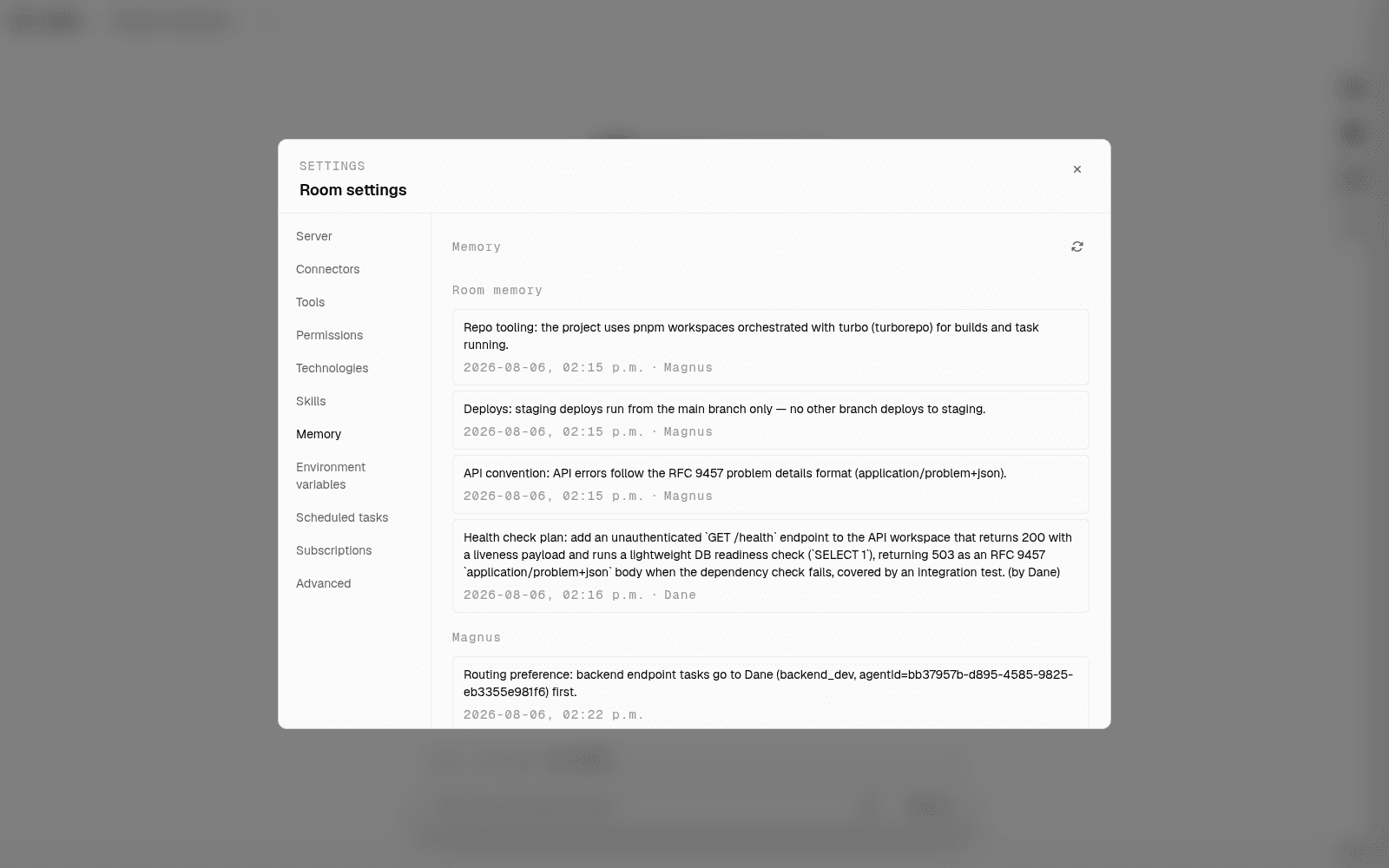
Feedback is a memory you can read and correct. A Memory tab in room settings lists every entry with its author. Tell an agent that a fact is stale and it deletes the entry. Every later run starts from the corrected state.
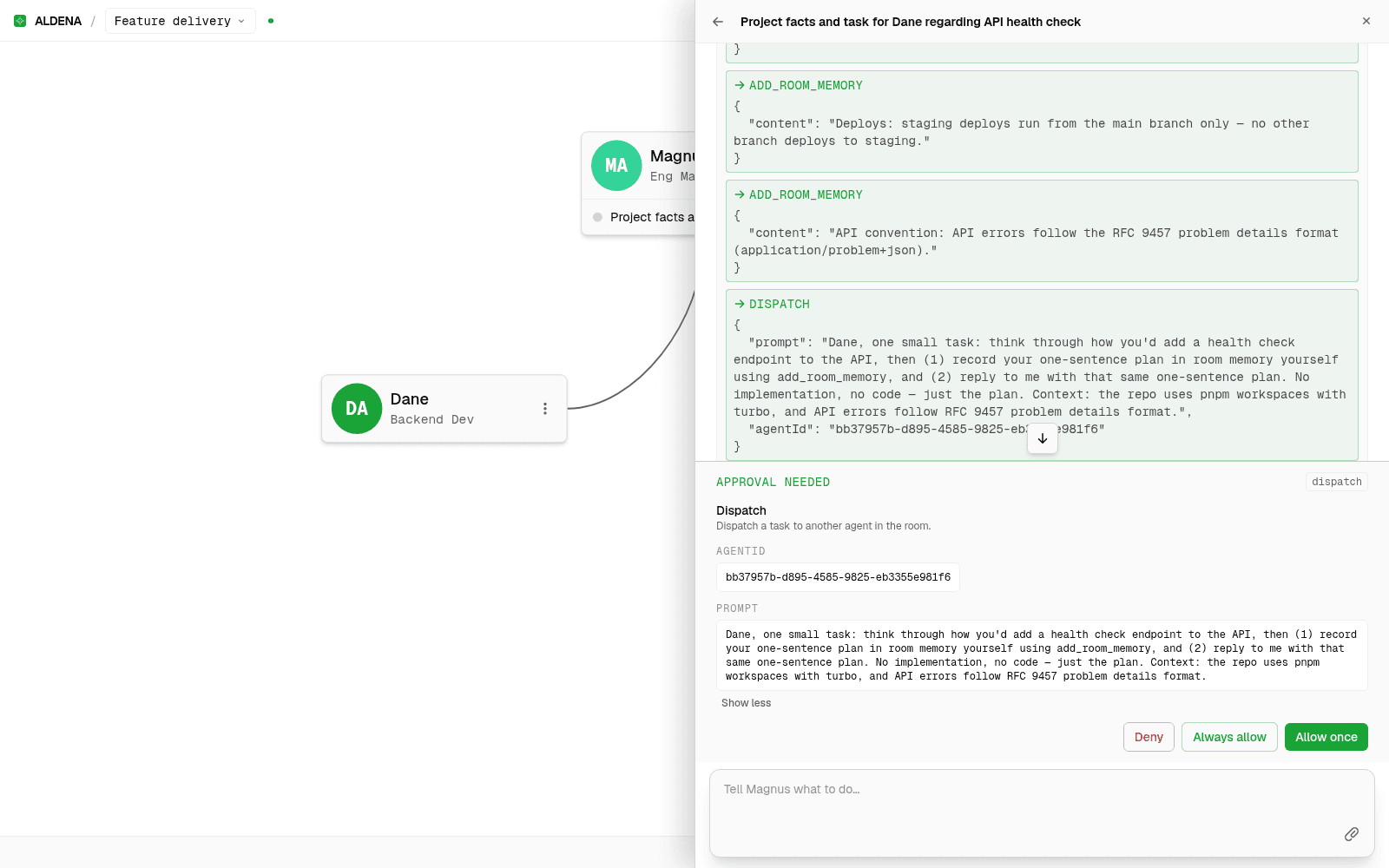
And every risky action has a gate. Every tool an agent can call runs under an allow, ask, or deny policy that you set. Anything set to ask pauses the run and shows you the exact call before it happens. Engineering work lands as an open pull request. The merge tool is gated like every other write, and the delivery role is told to leave its own request alone. It travels through the room's own connections, into GitHub or Jira or wherever else that room is connected. Agents act freely inside the room, and a human decides on anything that leaves it.
If you want the step-by-step of staffing and shaping a team like this, read how to build an AI agent team.
The test I run before reaching for a team
Three questions, answered honestly:
- Can I write this task as one job with one definition of done? If yes, use one agent and stop reading.
- Would an independent second opinion change the outcome enough to pay for a second agent's tokens?
- Are there pieces that can genuinely run at once, or role boundaries that must be enforced rather than suggested?
A yes to the first question outweighs everything else. A yes to both the second and the third tells me the coordination cost will pay for itself. When you do build the team, build the smallest one that still ships the work. Every agent you add is one more thing to coordinate and one more context to keep correct. It is also one more place where a fact can go missing.
spin up your first room.
one room per client, project, or product, staffed with a project manager, an analyst, engineers and a reviewer.