Your first AI employee: what changes in week one
Hiring an AI employee is a shift from tools you operate to teammates that deliver. What to delegate first, and why a small team beats a lone hire.

The shift lands on you before it lands on the AI
Genspark's Workspace 3.0 launch post puts the moment in one line: you don't work with AI anymore, you hire AI to work for you. I think that line is right, and I run a platform built on the same idea. But the launch posts skip the part that decides whether the hire works. That part is the first week. Nothing about the AI changes in that week. Everything about your job does.
The day you make your first AI hire, you stop being an operator and start being a manager. An operator holds all the context, drives the tool, and checks every output before it counts. A manager writes the job description, hands over a piece of work, and reviews what comes back. Most people who give up on AI employees never made that switch. They hired a teammate and then kept using it like a chat window. That is like hiring a contractor and then telling them which key to press next.
This is the post I wanted to read before my own first hire. What changes for you, what the first week looks like, what to hand over first, and why I now think one employee is the wrong thing to hire.
A tool waits for you, an employee delivers to you
Those words sound like marketing. The difference is mechanical. A tool holds its output until you collect it. You paste code out of a chat window. You download the draft. You copy the answer into the ticket. Every step passes through your hands, so your attention sets the limit on what the tool can produce.
An employee finishes its work inside your own systems. Work goes in as a request. It comes back as a pull request on your repository, a set of tickets in your tracker, or a document in your drive. You review the delivery, not the chat transcript. I wrote the fuller definition in what an AI employee actually is. The difference is not intelligence, it is packaging. A role with a defined scope. Memory that survives the session. Permissions that limit what it can touch. Delivery into the places your work already lives.
That last part is what makes it fair to say you hire an AI employee. Nobody says they hired their compiler. The word starts to fit when you can be somewhere else while the work happens. You come back later and the finished work is already in your repository or your tracker.
The first week, honestly
Every launch post makes the first week sound like magic. My first week was slower than doing the work myself. I now think that is the correct experience. You do not save time in week one. You transfer context, the same way you would with a junior hire who starts on Monday.
Day one is onboarding, and onboarding means telling it things. The repository. The default branch. Which environment is which. The conventions nobody ever wrote down. The things it must never touch. Google's AI Overview for this question said the same thing when I checked it in 2026: write a job description that sets tasks, rules, and limits. That is accurate. Every fact you state once should land in memory that lasts. An employee that asks for the repository URL twice is not an employee.
Days two and three are the first delegations, and they are noisy on purpose. A good first setup turns approvals on for anything that writes. The agent then stops and shows you each risky action before it runs. You will answer a lot of questions. Which environment. Is this in scope. Should the database migration go in this change or a separate one. Answer them properly. A question you answer in week one stops arriving in week three, because the answer sticks.
Days four and five bring the first real delivery. A pull request with the changed lines, the test results, and the reasoning behind them, waiting for your review. This is the moment the working relationship forms or fails. Review it the way you would review the first pull request from a new teammate. Seriously, with comments, expecting a second version. Approve it without reading and you have hired a random text generator. Review it properly and you have started a feedback loop that improves every round.
By the end of week one you have spent more time than the work was worth. By week four the same kind of task goes from request to finished delivery without you in the middle. That is the trade you made.
What to delegate first
The first delegation decides how much you trust the second one. Pick it the way you would pick a new hire's first assignment. Three properties matter.
First, a clear definition of done. A bug with steps to reproduce it beats "make the app better". A spec, meaning a short written plan with acceptance criteria, beats a rough idea. Vague work can come later, once the team has earned your trust. Do not spend week one on it.
Second, output you can check. Prefer work where a test suite, a build, or a checklist says pass or fail before you even look. Code with tests. A backlog split into tickets you can read in one sitting. A research summary with sources you can check yourself.
Third, damage that is easy to undo. Nothing customer-facing. Nothing permanent. Nothing that touches production credentials. Week one is for calibration, and calibration only works when being wrong is cheap.
The first delegations that worked best for me and for early aldena teams are plain ones. Reproduce and fix a known bug, then add a regression test so it cannot come back. Turn a rough feature request into a written spec with acceptance criteria. Split an approved spec into tickets. Run a review pass over an existing set of changes. What I would not hand over first: anything that depends on taste, anything with office politics in it, anything where you cannot say what good looks like. A teammate cannot hit a target you cannot describe.
One employee is a bottleneck with a name
This is where I disagree with the single-employee idea. Genspark's model, as described in that launch post, is one AI employee in its own cloud computer. You message it from WhatsApp, Telegram, Teams, or Slack. That is a clear model, and for personal task-running it may be the right one. For delivery work, one generalist brings back the problem you were trying to escape. One context, one queue, and no handoffs.
Real work is built out of handoffs. Someone clarifies the requirement before anyone builds. Someone else reviews the result after. Put all of that inside one worker, human or AI, and two things go wrong. Requirements get guessed at, and the author reviews their own work far too kindly. An agent that just wrote five hundred lines is the worst reader of those lines. I am the same about my own code late at night.
A small team with a reporting line fixes this through structure, not through better prompting. An analyst whose only job is to ask the clarifying questions before anything is built. A developer who builds against the spec that comes out of it. A reviewer that reads the changes and reports findings, and is not allowed to edit what it reviews. A manager that routes the work and is not allowed to write code. The limits are the point. A handoff between two roles with different jobs is where errors get caught. A solo employee has no handoff at all. I wrote the longer version of this argument in how to build an AI agent team.
The surprising part is that a team is not harder to hire than one agent. It is the same setup, done three times, plus an org chart.
How the first hire works in aldena
I can show this part instead of arguing it, because it is what I built. In aldena you hire into a room. A room is a separate workspace with its own server, its own connected integrations, and its own memory. One room covers one project. Agents in the room clone the repository onto that server, run commands there, and run the test suite there. Nothing they do reaches any other room.
You staff the room from a roster of prebuilt roles instead of one generalist. A normal first team is three of them: Vera the analyst, one developer, and Argus the reviewer. Then you draw the org chart, the picture of who reports to whom. Draw a line from each agent to its manager on the canvas. From then on work travels down the manager lines and results travel back up. You talk to the agent at the top and watch the work get handed out live. You write no orchestration code.
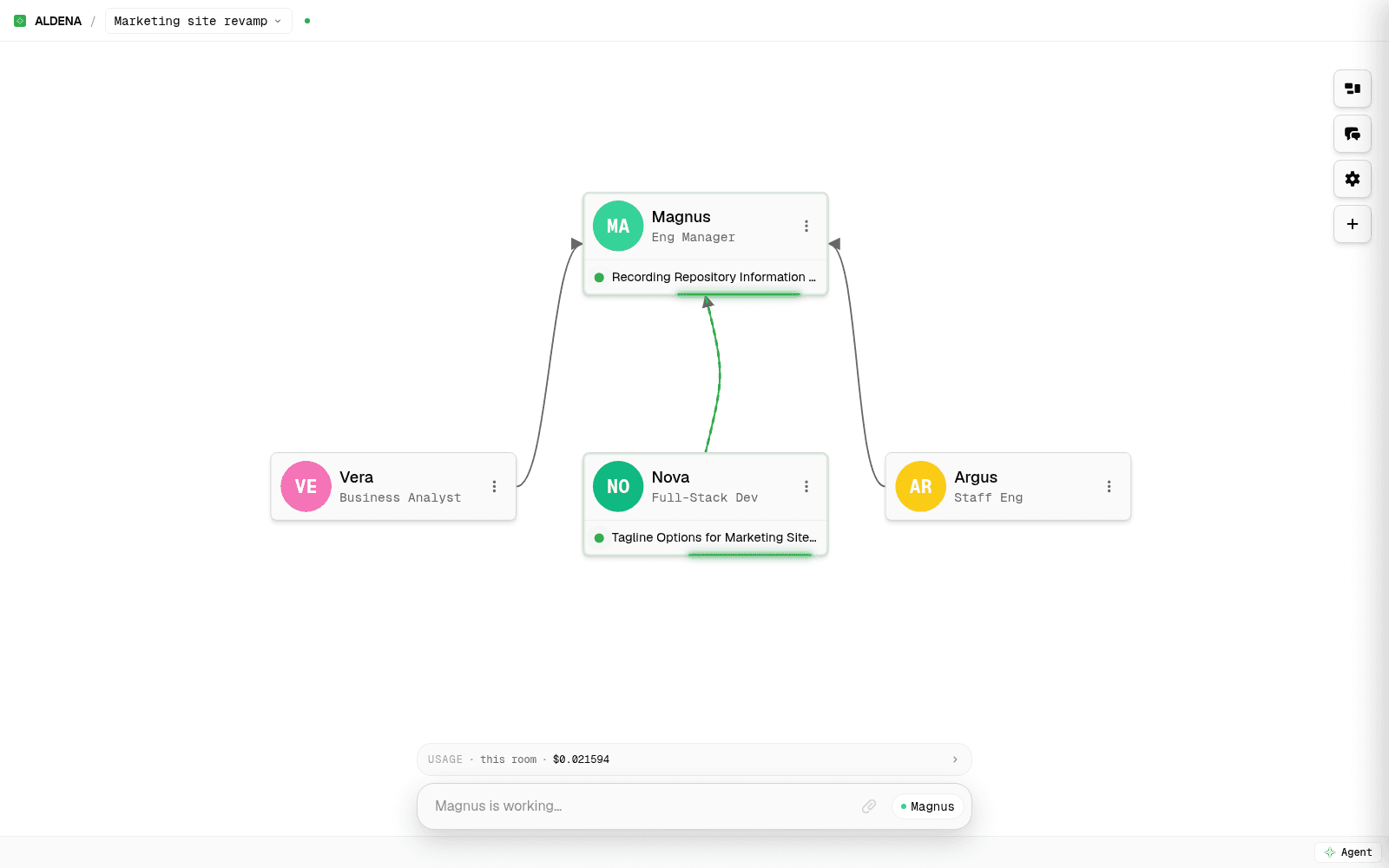
Onboarding here is the memory system doing its job. Lasting project facts go into shared room memory, a single store that every agent in the room reads. That means the repository, the default branch, the client, and the conventions. The store has a size cap and sits in a Memory tab, so you can read what the team believes and correct it. Each agent also keeps its own private working notes. Tell an agent a fact once and the next run starts already knowing it. That is the mechanical difference between onboarding an employee and re-prompting a tool.
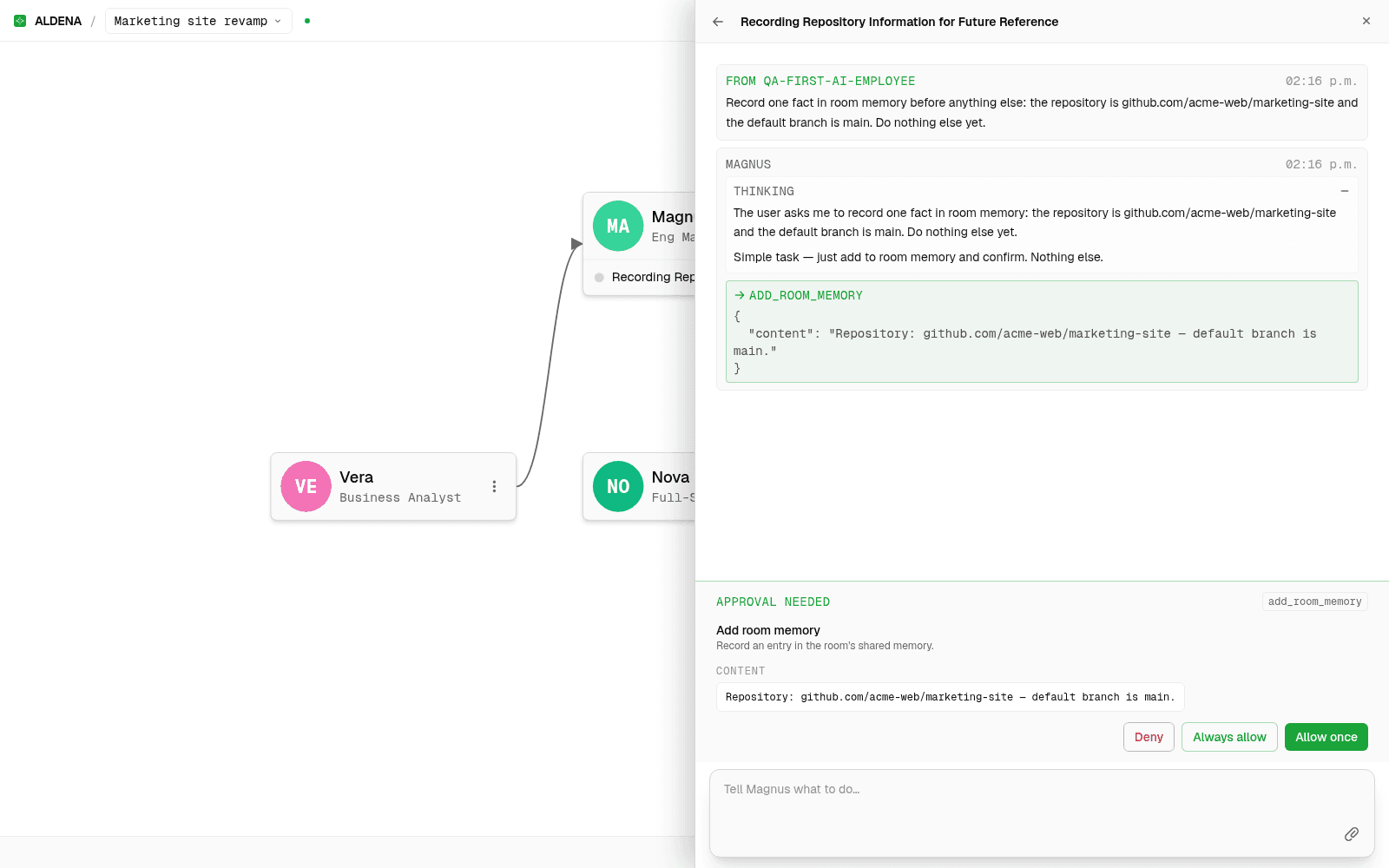
The trust problem from week one is handled by an approval gate, a rule that stops an agent and asks you first. Every tool an agent can reach carries one of three policies, set per room: allow, ask, or deny. On ask, the run pauses and shows you the exact action before it happens. Your answer resumes the run from that step, even a day later. Engineering work always ends the same way. The agents create a branch, commit, and open a pull request into GitHub or Bitbucket. The role that opens it does not merge it, and merging is a write tool that pauses for you as well. Tickets reach Jira or Linear the same way, shown to you for a go-ahead before anything is created.
The cost of the hire stays easy to see. Most platforms in this market avoid that. Model usage bills at the provider's list rates from one prepaid balance. A room's server costs a few cents an hour, with the current rates on the pricing page. If the balance runs out, work pauses instead of running up a bill.
Make the first hire smaller than the launch posts suggest
The launch posts describe this moment as the end of an era. The practical version is much smaller, and I mean that as advice. One room. Three roles: an analyst, a developer, a reviewer. One small project with a real definition of done. Approvals set to ask for everything that writes. One week of answering questions properly. Then judge the hire the only way that counts. Open the pull requests and read them.
If they are good, you did not find a better tool. You made a hire, and the second one is easier. If you are still comparing platforms for that first hire, choosing an AI employee platform comes down to a short list of questions. I would ask any vendor the same ones, including me.
spin up your first room.
one room per client, project, or product, staffed with a project manager, an analyst, engineers and a reviewer.