start using Linear with your agents
sign up, open a room, and authorise Linear from its connectors settings.
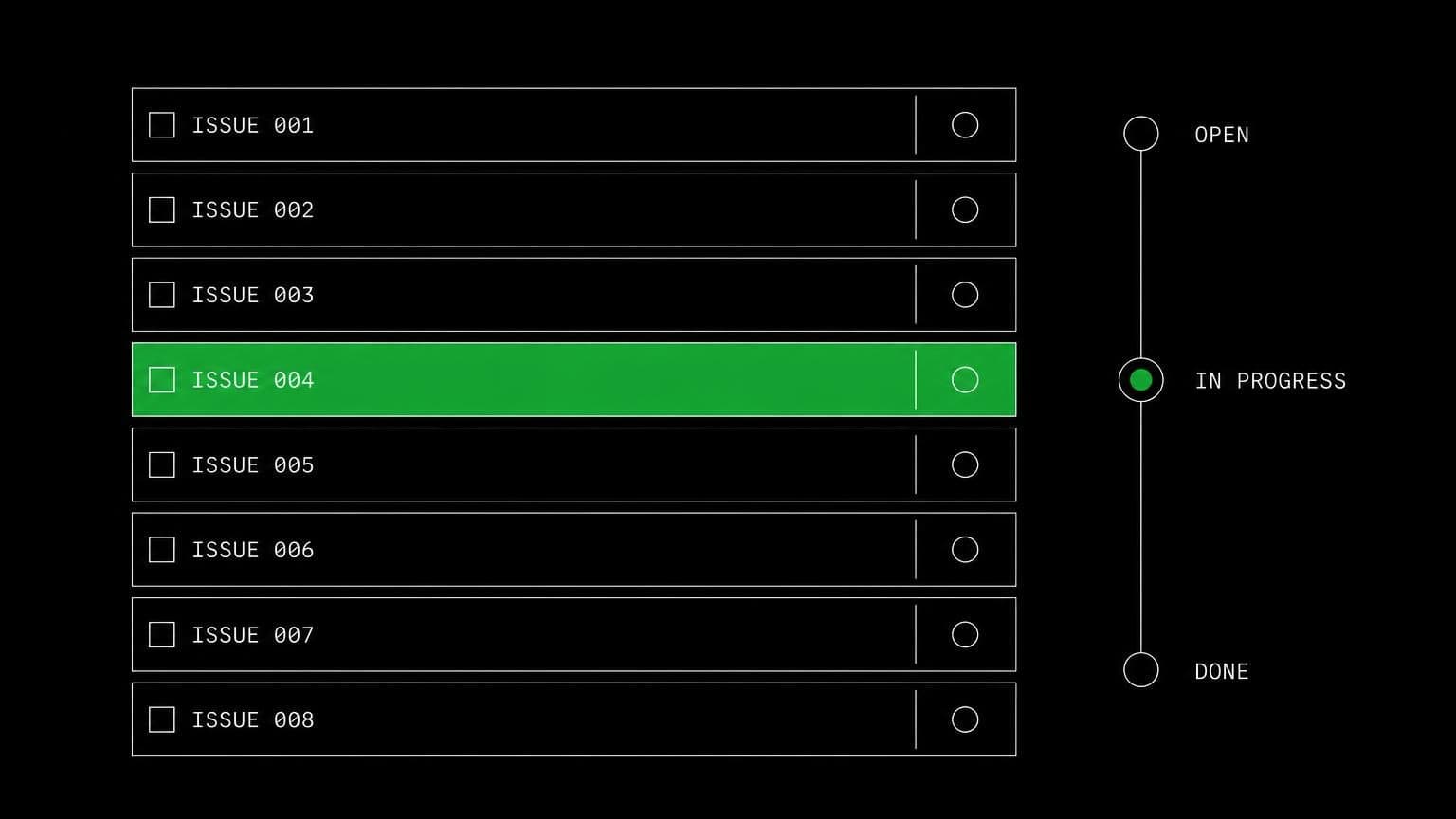
ai agent for linear: read the issue, ship it, move the state
connect linear to a room and its agents search issues, create and update them, change workflow state, comment, relate issues, and build the change described.
- read tools
- 8
- write tools
- 6
- scopes
- 4
linear is where the work is described, and a room is where it gets done. linear_get_issue reads an issue by its identifier, linear_search_issues filters across the workspace with an optional free-text term, and linear_list_teams, linear_list_projects, linear_list_issue_statuses and linear_list_labels give an agent the real vocabulary of your workspace rather than a guess at it. linear_lookup_user resolves a display name or an email to the person an issue should be assigned to.
writing back in your workflow's own language
linear_create_issue files work, linear_update_issue edits fields including the workflow state, linear_add_comment posts markdown, and linear_create_issue_relation relates, blocks, or marks two issues as duplicates. each of those is a mutating tool, so it stops for approval before it runs. read tools never do, which means an agent can always answer what is in flight without being able to change any of it.
the part other linear integrations skip
an assistant that summarises your cycle is useful for about a minute. because the room owns a server, the agent that read the issue can clone the repository onto it, edit files, run the test suite, and open the pull request, then come back and set the state to in review with the link attached. that whole chain happens in one room, in a chat you can watch, with approval gates on the steps that change something.
example tasks
- 01
take the top unstarted issue on the web team and get it to in review.
the agent reads the issue, moves it to in progress, does the work on the room server, opens the pull request, comments the link, and moves it to in review.
linear_search_issueslinear_update_issuebashlinear_add_commentlinear_update_issue - 02
file the bugs from this thread and block them on the migration issue.
it creates one issue per bug with the right team and labels, then relates each of them to the migration issue as a blocker.
linear_list_labelslinear_create_issuelinear_create_issue_relation - 03
watch the platform team and draft a plan whenever something new arrives.
the team subscription wakes the agent in this chat on creations, updates and comments, and it reads the issue and the team's statuses before proposing an approach.
linear_subscribelinear_get_issuelinear_list_issue_statuses
what it will not do
workspace administration, cycle and project configuration, and member management are outside the tool set. an agent cannot delete an issue, and it cannot reach a workspace the connected account was never given.
what agents can call
every Linear tool an agent in a connected room can reach, split by whether it only reads or changes something. read tools are allowed by default, write tools stop for your approval, and the room's tool permissions can move any of them either way.
linear_get_issueRead a single issue by identifier.
linear_search_issuesSearch issues with filters and an optional free-text term.
linear_list_teamsList the workspace's teams.
linear_list_projectsList projects, optionally filtered by team.
linear_list_issue_statusesList a team's workflow states.
linear_list_labelsList workspace and team labels.
linear_lookup_userFind a Linear user by display name or email.
linear_get_granted_scopesRead the connection's granted scopes.
linear_create_issueCreate a new issue.
linear_update_issueEdit an issue's fields, including its workflow state.
linear_add_commentAdd a markdown comment to an issue.
linear_create_issue_relationRelate, block, or mark two issues as duplicates.
linear_subscribeSubscribe the agent to creations, updates, and comments on a Linear issue or team.
linear_unsubscribeCancel one of the agent's Linear event subscriptions.
what you grant
scopes are chosen when the room connects Linear, and they can be changed later by reconnecting. anything marked off by default stays off until someone deliberately turns it on.
- Read issues & projectson by default
Read and search issues, teams, projects, workflow states, and labels.
- Create & edit issueson by defaultneeds work_read
Create, edit, comment on, and relate issues.
- Look up userson by default
Look up Linear users for assignments and mentions.
- Event subscriptionson by default
Let agents subscribe to Linear issue creations, updates, and comments and receive a notification in the chat where they subscribed.
how to connect Linear
connecting Linear takes one oauth round trip, started from inside the room that needs it.
- open the room's connectors settings
connections belong to a room, not to your account and not to the team. open the room that needs Linear and go to its connectors panel. connecting it in one room leaves every other room untouched.
- authorise with a real account
any member of the room can start the oauth flow, and they authorise as themselves, so Linear records a real identity on every action instead of an anonymous shared bot.
- choose the scopes for this room
the scopes are ticked before you are handed to Linear, so the consent screen asks for exactly what the room needs and nothing more. a scope that depends on another cannot be ticked alone. the granted set is fixed once the connection exists, so widening it later means reconnecting.
- the room's agents pick up the tools
every agent in that room can now call the Linear tools the granted scopes cover. mutating tools still stop for approval, and disconnecting takes the tools away again in one click.
data handling and security
the objection to an agent with write access is noise: a wrong edit, a wrong comment, a wrong merge. the answer is that nothing mutating happens without a person, and nothing crosses a room boundary.
- one connection, one room
the Linear credential is stored against the room it was authorised in. no tool in another room can read it, and there is no team-wide connection to inherit by accident.
- scopes bound at the tool layer
a Linear tool that needs a scope the room did not grant is not offered to the agent at all, so a model cannot talk itself into an action nobody authorised.
- approval before anything changes
mutating tools pause the run and wait for a human. you allow once, allow always for that room, or deny, and the agent carries on with the answer.
- an audit trail you can read
every call is a message in the room's chat with its arguments and its result, in the order it happened, so a surprising change is traceable rather than mysterious.
- revocation is one click
disconnect Linear and the tools disappear from the room immediately, along with the stored credential and any event subscriptions the agents had opened.
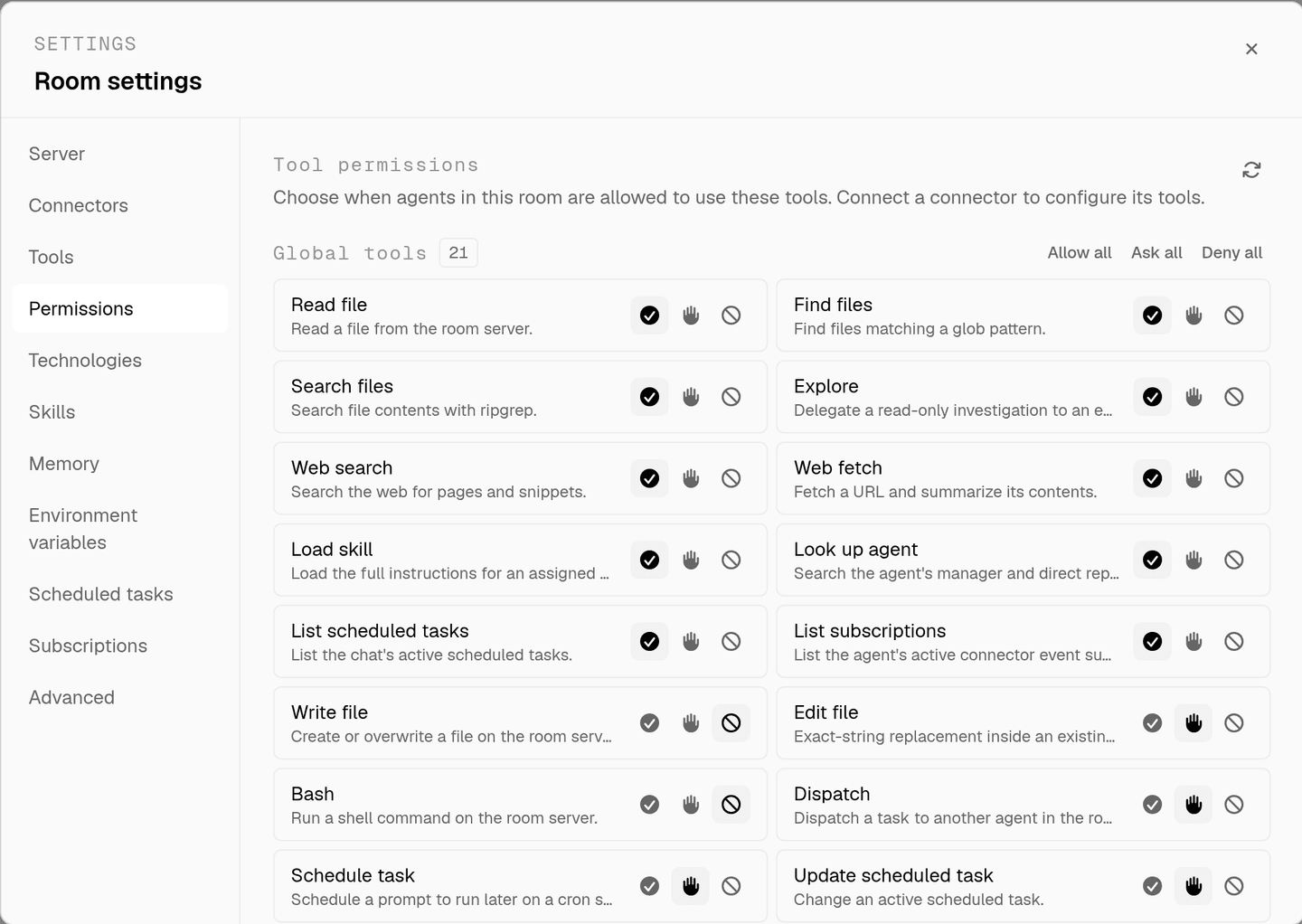
the full approval model, including what agents ask you mid-run, is on human in the loop, and room isolation is on isolated rooms.
faq
can an ai agent create and update linear issues?
yes. linear_create_issue files new work and linear_update_issue edits fields including the workflow state, so an agent can move an issue to in progress when it starts and to in review when the pull request is up. both are mutating tools and ask for your approval first.
does the agent understand my team's workflow states?
linear_list_issue_statuses reads the actual workflow states for a team rather than assuming the defaults, and linear_list_labels reads the workspace and team labels. an agent checks the real names before it tries to move anything into them.
which linear scopes does a room need?
read issues and projects for search and metadata, create and edit issues for writing, and look up users for assignments and mentions. event subscriptions is separate again. linear scopes are chosen before the oauth handoff, so widening them later means reconnecting the room.
can the agent do the engineering work, not just the ticket admin?
yes, and that is the reason to connect linear to a room rather than to a chat bot. the room owns a server, so the same agent that reads the issue clones the repository, writes the change, runs the tests, and opens the pull request before it updates the state.
how does an agent react to a new issue without being asked?
linear_subscribe attaches it to an issue or a whole team. creations, updates and comments then wake the agent in the chat where it subscribed, so triage can start the moment something lands in the team's inbox.
spin up your first room.
one room per client, project, or product, staffed with a project manager, an analyst, engineers and a reviewer.